COTTAGE GROVE – Incomplete financial audits and accounting inaccuracies have led the City of Cottage Grove to address budget challenges for the next fiscal year.
In January of this year, interim finance director Eric Kytola shared his findings of the City’s budgeting errors with the city council.
“There were some problems that surfaced about the beginning fund balances during the FY2026 year; they’re not right,” Kytola said during the Jan. 26 city council meeting. “In September 2025, after the 26 budget was already adopted, I started working on the FY2024 audit preparation and found some mistakes. These mistakes are adversely affecting the fund balances, and the size of the mistakes is substantial.”
He said the financial data is missing due to incomplete audits.
“FY2022 was the last year that there were audited financial statements. I realize you guys have got the 23 audit now, but that wasn’t the case when I was writing this up. So the audits are years behind schedule,” Kytola said.
Since 2022 was the last year with audited financial statements, that means there were two years of missing actual data for the FY2026 budget prep. The numbers that were used to determine future budgets were inaccurate.
Again, in September last year, Kytola found that the FY2023 audited financial statements were incomplete. They were in “draft form,” which means the preparer had drafted the statements, but the auditors had not signed off on them yet. However, according to Kytola, it is fairly certain the auditors would have agreed with the statements. The unaudited statements were then used by Kytola to review beginning fund balances for FY2024.
When reviewing the FY2024 data, Kytola found substantial critical accounting errors. The first one is only portions of the supplemental budgets being entered into the software.
“In accounting, you have balanced transactions. There’s always numbers happening in two accounts at the same time, and some of the supplemental budgets only had a number happening in one,” he said. “When you ran the revenue and expenditure reports, the budget column wasn’t balanced, which was a very clear indication that the supplemental budgets had not been entered into the software all the way. That also means that every director looking at their revenue and expenditure reports was looking at data that was wrong.”
Kytola said he has already taken steps to correct the issue, such as entering all supplemental budgets into the software and ensuring the budget column in reports remains balanced in the future.
He also found debt payments that were not accurately entered in the accounting software. He explained that debt is paid out of Fund 817 and that, for that fund to have money, an accountant must create a journal entry that transfers funds from eight different accounts into Fund 817. If that journal entry is not made, the money is not transferred out of the other accounts for the debt fund, making it appear there is more money in the other eight accounts.
Another mistake Kytola uncovered was a nearly $3 million error. A $2.9 million purchase of land for Project Sparrow on the south end of town was recorded in the General Fund as revenue, rather than expenditure. This error caused the General Fund to appear almost $3 million healthier than it really was. The loan and purchase entry was created in 2023 and the mistake was never caught or fixed for two years until Kytola discovered it.
The city uses an adopted budget as a guide for conducting business and planning expenditures. However, due to budgeting mistakes in previous years, the guide has been inaccurate. The misreported balances created negative balances in four funds by the end of FY2025.
- Street Fund: –$271,192
- Water Fund: –$9,052
- Industrial Park: –$98,587
- General Reserve: –$187,644
“Because fiscal year 25 has already passed, the last day was June 30th of 2025; we can’t go back and do supplemental budgets to fix any of this,” Kytola said. “This is going to be an issue with the audit. There’s nothing we can do about it.”
The FY2025 adopted budget had $13,876,675 in ending fund balance; however, Kytola actually calculated $11,714,352, a difference of $2,162,324.
In addition to the accounting errors in the city budget software, Oregon law limits the amount of property tax cities can collect. Measures 5 and 50 cap the property taxes cities can collect and the rate at which property values can grow for taxation. These laws restrict Cottage Grove’s ability to increase local revenue, even when service costs increase.
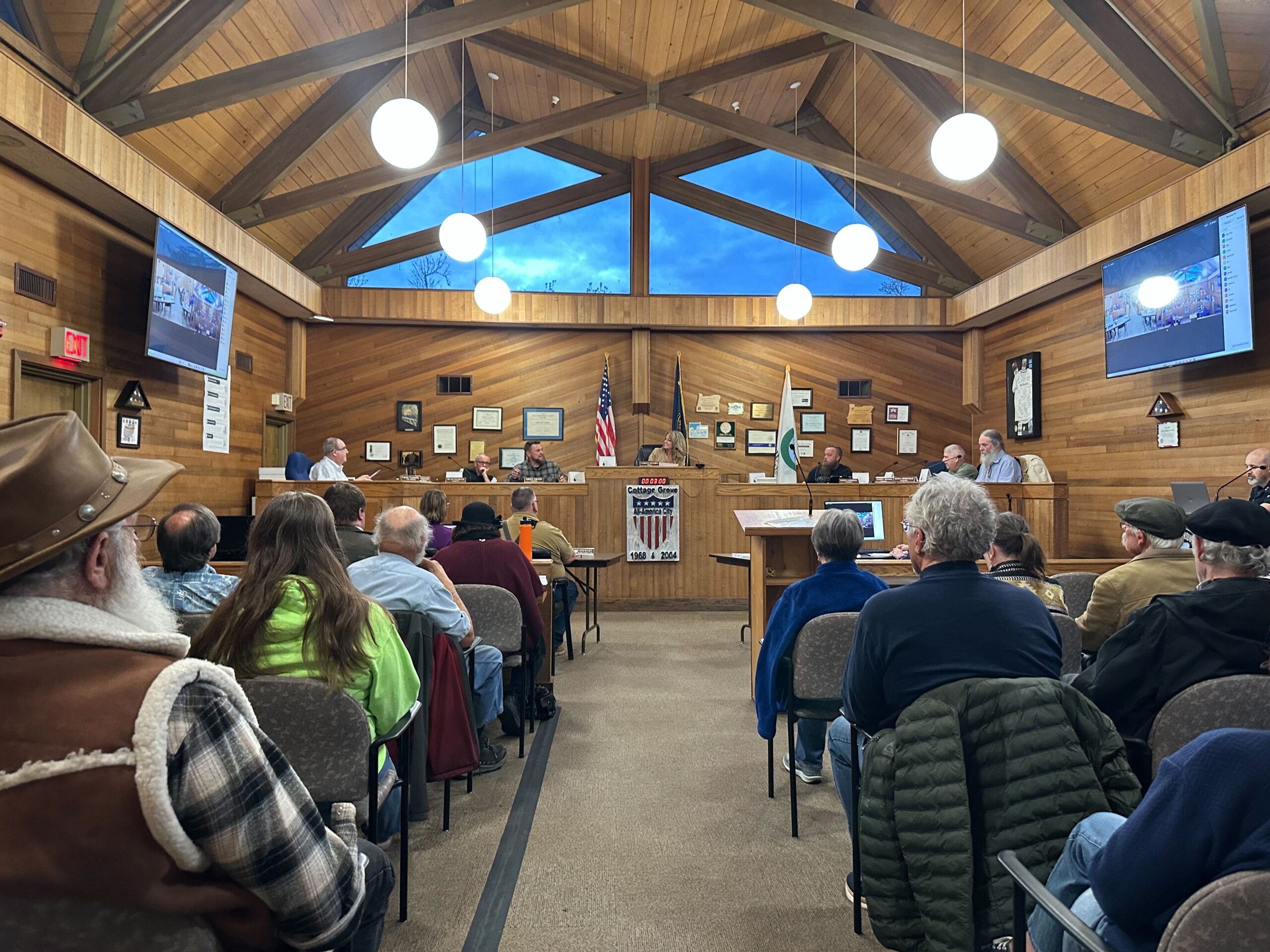
City councilor Dana Merryday explained the impacts of the measures during the April 13 city council meeting.
“What that has done for the listening audience is lock our property values at an unrealistic level, and allows the assessed value to only increase 3% per year. So we’re starting way behind the finish line. We’re locked in at a rate that will not match the rise in cost. The exact same thing is happening to the city, to the county, and the state,” Merryday said.
All of these issues compound, and the result is that, with the information available now, the FY2026 Beginning Fund Balance numbers look to be about $4.5 million more than they should be.
Next steps
The proposed FY2026 budget was built with incomplete information. Changes to the proposed budget and the current fiscal year budget are underway to address these financial errors.
“I think we’ve identified what the problem is,” said Mike Sauerwein, city manager. “The obvious question is where do we go from here and what do we do about it?”
On April 13, Sauerwein gave a presentation to the council on what the budget officer’s report will be for the proposed 2026-27 budget. The serious accounting problems have been rectified, and City staff have implemented policies and procedures to prevent them from re-occurring.
Sauerwein said significant budget adjustments are needed for the 2025-2026 budget, including a $4.54 million reduction.
“This is what you call cleaning up a mess, guys,” Sauerwein said. “This is how we’re righting the ship.”
Changes to staffing levels are reflected in the 2024-2025 and 2025-2026 budgets. In 2024-2025, many city staff positions were not included in the budget, including the assistant city manager, maintenance worker, police officer, sergeant, and community coordinator.
For the 2025-2026 year, positions for community development director, residential building inspector, and building official have not been included in the budget, but a part-time commercial building inspector, associate planner, and police sergeant have been added.
The proposed 2026-2027 budget reflects changes to the library model. Although this is only one of several options under consideration, the change would look like moving from a staffed facility to a full-time head librarian supported by volunteers.
“Reasonable minds can disagree on the allocation of resources. That’s why we have 14 people on the budget committee,” he said. “We want to hear a lot of different input and a lot of different opinions. What I would recommend is that any changes that people want to make to the General Fund proposed budget – be balanced. Not only talk about the things you do want to fund, but also talk about the things that you’re willing to reduce.”
He called the General Fund Balance extremely tight with little or no flexibility.
The bare minimum the City needs in the General Fund Unappropriated Ending Fund Balance in order to meet expenses is $1.7 million. Sauerwein said they are budgeting $1.6 million, along with $200,000 for contingency.
He pointed out that these numbers are cutting it close. If the HVAC system goes out in City Hall or another snowstorm plows through the town, $200,000 can be spent fairly quickly.
Impact on utility rates
Operating costs will increase. Capital costs for water, wastewater, and stormwater improvement are actually being reduced in the proposed 2026-2027 budget; however, operating costs are going up.
“Unfortunately, like everybody else, with Bonneville Power Administration raising its rates, we use a lot of electricity to produce water and take care of sewage. We also use petrochemicals, and the price of petroleum is certainly being impacted. As a result, our operations costs are actually increasing,” Sauerwein said.
A typical single-family home using around 5,000 gallons of water per month can expect to see an increase of $10.76 on its utility bill. This is an increase of about 7%.
“What we’re hoping going forward is that we’ll be able to, over the next three years after that, reduce that increase to where it will be at basically the rate of inflation, 3-4%.”
Upcoming meetings
The proposed Fiscal Year 2026–27 Budget will be presented to the Budget Committee at Cottage Grove City Hall at 6 p.m. on April 21 and April 30, with a third meeting scheduled for May 19 if needed.
A Public Hearing will take place at the first Budget Committee meeting to receive public comments on the proposed use of State Shared Revenues.
In addition to the City Hall sessions, the City Council will host a community Town Hall at the Cottage Grove Armory on April 23 at 6 p.m.