CRESWELL – A Creswell woman has been extradited to Lane County after fleeing felony animal abuse convictions in 2019, which was identified by the County as the largest horse seizure in Lane County history.
In 2020, Creswell resident Gwenyth Ellen Davies, who was 49 at the time of conviction, pleaded guilty to 11 counts of animal neglect after 61 horses were seized from her property the year prior.
The deal imposed a five-year probation on Davies, during which she could own no more than four horses and was prohibited from caring for any others. Davies was also ordered to pay $18,540 to the Oregon Humane Society, $10,637.90 to Lane County, and $20,379 to another rescue organization in restitution.
But after the conviction, Davies disappeared.
Lane County Circuit Court issued an extraditable warrant for her arrest in 2023. A deputy determined that Davies was likely in California, notified local law enforcement, and continued the investigation as new information emerged.
In January of 2026, Davies was arrested on a warrant by the Los Angeles Police Department as she re-entered the U.S. at a port of entry in the Los Angeles area. Extradition was approved by the Oregon Governor’s Office. On Feb. 12, Davies, now 55, was lodged at the Lane County Jail on the warrant.
Back then
In October of 2019, Lane County Sheriff’s deputies served a search warrant at a property in the 33000 block of Camas Swale Road. Davies resided at the property with her husband, Michael DeLeonardo, who was a farrier.
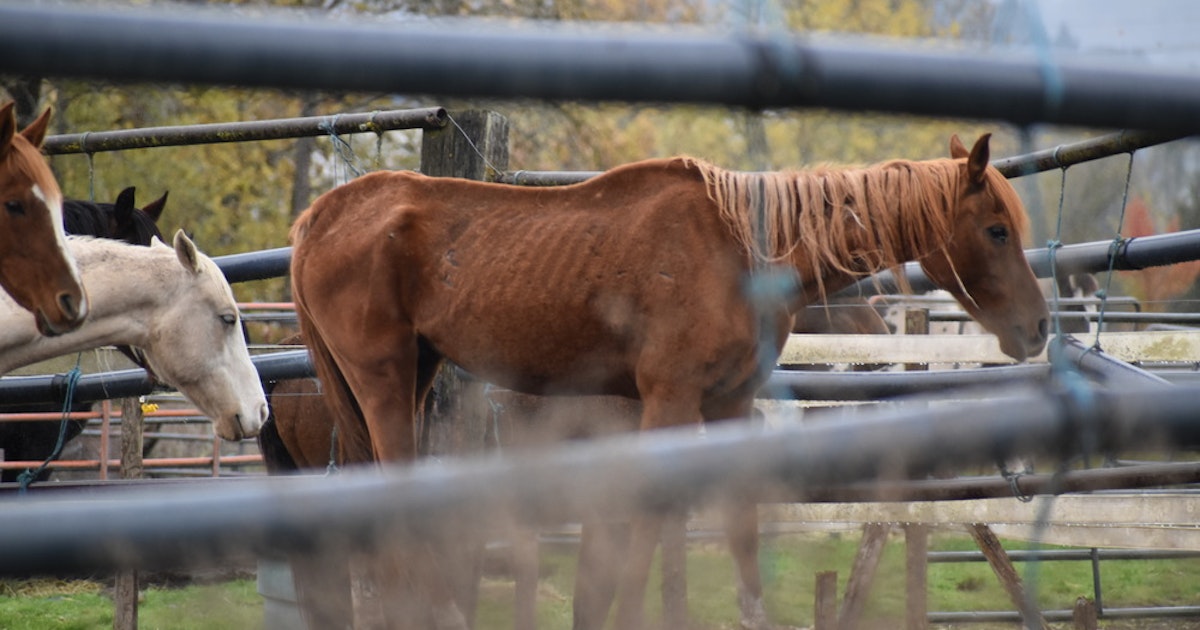
The seizure resulted from years of accumulated complaints from neighbors, several sources said in 2019. After damning photos of starving horses surfaced, it kicked the case into high gear.
For neighbors, it was a sigh of relief to see trailer after trailer haul off the horses from Davies’ property – so much so, they pulled out lawn chairs, counting trailers as they passed.
“We’ve been waiting for this day,” said neighbor Andy Davis back in 2019, who grew concerned when he never saw any rigs dropping off hay or supplies. With over 60 horses, a semi-truck’s volume could be devoured in a week, he said.
He said his family would literally cheer with excitement when he saw the horses being fed; however, only a single bale of hay would be tossed in the enclosure. The horses gorged themselves, and that would be all for another four or five days, he said.
Wayne and Mary Walborn of Roseburg owned the 25-acre property before selling it to Davies in January 2018.
”It’s worse than you could imagine,” Wayne said in a 2019 on-site interview, as he stood on the bordering property, pointing to broken, jagged fencing, dilapidated structures, and gnawed fence posts.
Sierra Jones, of Creswell, used to board her horses with the Walborns. Within a few days of Davies’s ownership, Jones said she noticed horses were irregularly fed and were not being taken out of their unkempt stables. Water tubs were slimy, and the horse feces in the stalls mounted, infested with maggots, Jones said.
Within two weeks, Jones pulled her horses from the boarding facility.
The barn had 32 stalls, said Mary, who said she knew the land like the back of her hand. There were no additional horse shelters on the property, she said, so half of the horses were stuck outside in all weather, unprotected, starving, and sick.
The L-shaped property stretches a half-mile back, where Davies’ property and Camas Swale Creek meet. Wayne and Sandy Huey, who operated Emerald Valley Equine Assistance Horse Rescue, identified horse bones, legs, and horsehide sticking out of shallow graves on the embankment.
The siege lasted all day, during which 61 horses were removed from the property. They were transported to the Lane County Fairgrounds for a health evaluation. Many of the horses were found to be emaciated and malnourished, and several horse carcasses were discovered on the property.
The last of the horses were taken to Sound Equine Options, a rescue organization based in Gresham.
Upon arrival, the horses were lethargic and ”checked out,” with big, black, dead eyes, as though the light in their eyes had burnt out, said Kim Mosiman, SEO executive director, in a 2019 interview.
“The horses were just focused on surviving; they had become very internal at that stage,” Mosiman said.
Three of the horses died, and 37 ranked in an unhealthy body score, with 19 horses being “walking skeletons,” Mosiman said. “One horse was basically the skinniest it could be and still be alive.”
Devon Ashbridge, public information officer for the county, said in 2019 that this was “by far the largest horse rescue in Lane County history, certainly within the last 30 years,” noting the only other comparable instance was in January 2018 when eight horses were seized from another Creswell farm.