
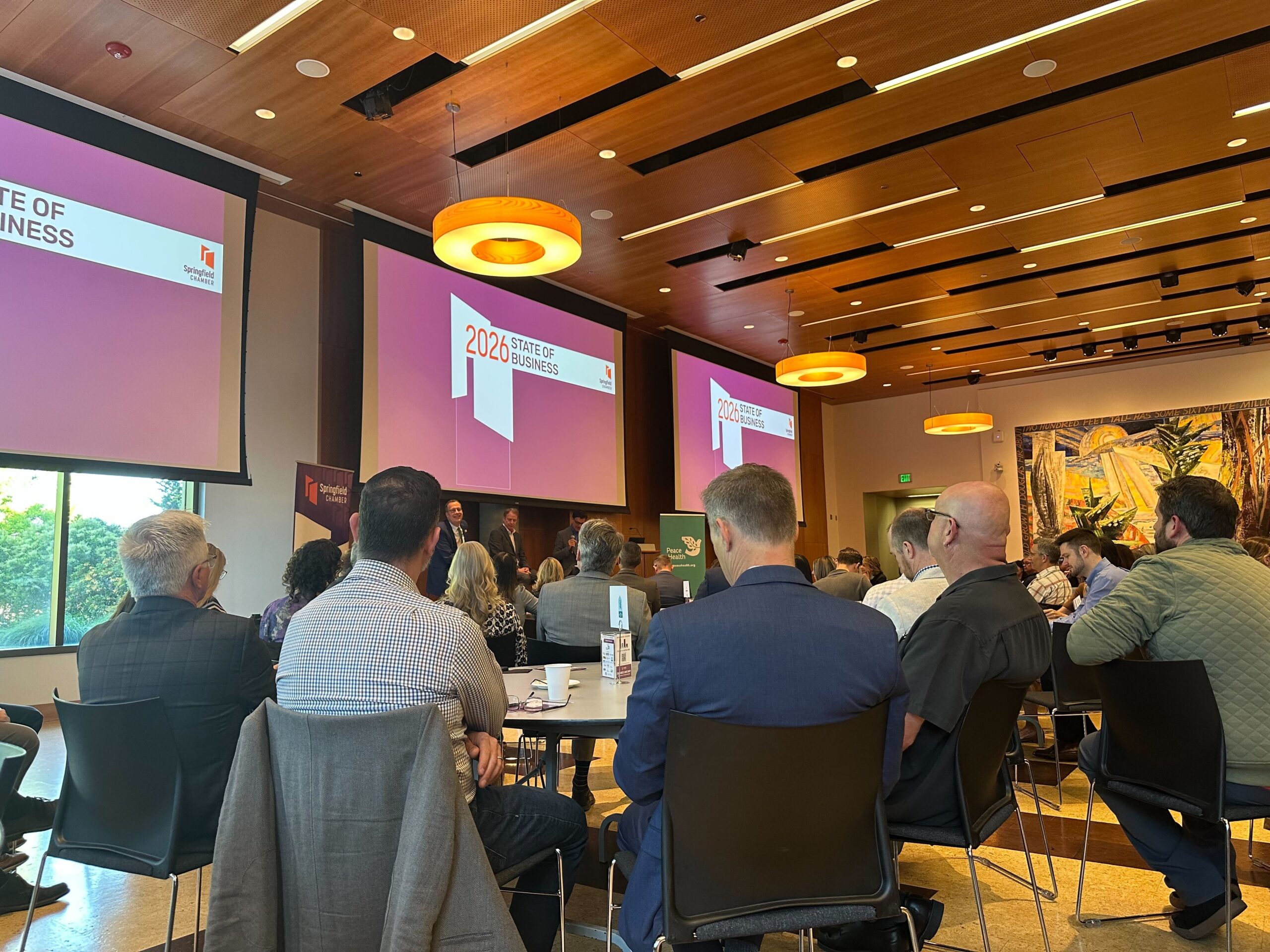
EUGENE – Last week, the Springfield Area Chamber of Commerce hosted the eighth annual 2026 State of Business program, featuring distinguished guest speakers who provided an outlook for businesses in Oregon. The program highlighted economic challenges and opportunities in the region.
Local businesses such as Springfield Utility Board, Lane Transit District, PeaceHealth, and Chambers Construction attended the event to learn about the region’s demographic shifts, workforce challenges, and the need for innovation and regional alignment.
Chamber president and CEO Vonnie Mikkelsen said, in addition to grounding members in the current economic realities facing businesses and communities across Oregon, the Chamber wanted to know what it will take for the local area to remain economically competitive.
John Tapogna, president of the Oregon Business Council, gave a presentation on the economic outlook Oregon faces. He said Oregon is in an atypical cycle and not keeping pace with growth.
He displayed a graph showing Oregon’s growth rate across different business sectors. Every sector except private education, health services, and leisure and hospitality experienced a decline in growth rates from January 2025 to January 2026. Private education and health services recorded a 2.7% growth rate, while leisure and hospitality recorded 0.9%.
“Since the pandemic, our gross domestic product (GDP) growth has been falling below that of the U.S. That is very atypical for this state,” Tapogna said.
He also shared that Oregon’s natural population growth has gone negative; another result of the pandemic was that deaths outpaced births in 2020.
“The old forecast was that deaths would outnumber births around 2025 or 2026 – where we are right now, but Covid accelerated that timeframe, and we’re in it,” he said.
Other pressures driving Oregon toward stagnation include structural challenges, such as high housing prices and the resulting homelessness crisis, K-12 schools among the lowest-performing in the United States, and overreliance on the individual income tax. Oregon crosses the U.S. in terms of spending per student, but also has some of the worst-performing achievement scores on the National Assessment of Education Progress.
“Many working systems, our schools, regulations, land use rules, and permitting processes were built for a different time. They were built largely for the ‘70s or before to solve the problems of that era of those days, but I would say that the future, as we sit here today, has never looked less like the past at any point in our history than it does right now,” Tapogna said.
Aside from some of the challenges Oregon is currently facing, Tapogna said Intel is central to the state’s economic future. Economist Mike Wilkerson said he has tried to find another state as dependent on a single private-sector actor as Oregon is on Intel, and claims you can’t.
Intel Corporation Common Stock has skyrocketed from around 45% to over 90% in 2026 alone.
“If you’re rooting for Oregon, you need to be rooting for Intel,” Tapogna said.
Finding solutions
After he shared the current conditions Oregon is facing, Tapogna invited Karl Scholz, the University of Oregon president, and Tim Knopp, the Chief Prosperity Officer for the State of Oregon, to a conversation about how to improve them.
They emphasized the importance of addressing regulatory barriers and improving workforce development. The discussion also touched on the need for improved infrastructure and permitting processes to attract and retain businesses, ultimately enhancing the region’s economic competitiveness.
Local businesses in the audience might not have the resources to invest in Intel or to transform their existing business into a technology-driven workspace. Springfield Mayor Sean VanGordon asked the trio what businesses and local governments can do now to be better positioned.
Knopp said local governments can address permitting regulations that limit development, ensure land is available for use, and make sure infrastructure plans are in place.
“If you attract talent to innovate, and can clean up some of the regulatory barriers that are inhibiting growth, the future could be incredibly, incredibly bright,” Scholz said