By Gordon Culbertson
Driving the backroads of Oregon, one notices the presence of small woodland owners. Signs indicating “Family Forest Owner” and the green-and-white diamond-shaped “Tree Farm” logo identify forests as well-managed, with a measure of pride. Family non-industrial forests total over 3.5 million acres, more than one-third of Oregon’s private forests.
These forest owners have unique goals, including wildlife habitat, timber production, recreation, or simply “peace and quiet.” Still, all share a desire to maintain healthy forests and a common ethic of valuing sustainability.
The commitment to healthy, productive, and diverse forests creates a strong bond. For many families, this heritage can be traced across generations. Grandchildren, now adults, are harvesting timber grown for decades from seedlings they planted as youngsters.
Esteemed forester Bob Mealey wrote a poem titled “When You’re So Old,” posing the question, why does an old man plant a tree?
Some of his answers are “so furry folk can have a home, birds can nest, and kids can roam, taxes for schools and roads, jobs and lumber for abodes…There is my family, folks who follow me; I’d like to leave them some land, stocked with trees and looking grand.” For many of us, Bob’s words sum up our family legacy and love for the land.
We work with nature as our partner on days good and bad. Too much or too little rain, wind, ice, disease, or insect epidemics sometimes complicate life. This is part of our legacy: learning from family, neighbors, and experts who have traveled the same road.
Over recent years, a disturbing new threat has become all too common. As legislators convene for the annual session, we often face legislation, however well-intentioned, that puts family forests at risk.
Hostile legislators
Many in the legislature are increasingly hostile to forest owners and operators.
Four years ago, Oregonians adopted the “Private Forest Accord,” which included new regulations purportedly to enhance habitat by increasing stream buffers. For our family, the “PFA” placed about 10 percent of our acreage off-limits to active forest management. This sacrifice was based on “regulatory certainty.”
So, are we certain that family forests are economically sustainable? That’s yet to be determined.
Unchecked taxes and regulations threaten viability, economic security, and sustainability for family forest owners. Decisions imposed are often based on mistaken notions of science, determining the well-being of our forest environment.
Will these policies help keep “family forests as forests?”
Forest policy decisions are dominated by, as my good friend and fellow tree farmer Kate says, “people who claim to care about forests, but have little knowledge of the work of caring for our forests.”
Bob Mealey spoke of his family forest legacy, noting, “These gifts I value more than gold, so I plant some trees, though I’m so old.”
Indeed, the long-term health of forests is at risk from natural effects of wildfire, disease, drought, and insects.
However, the fate of family forests rests in the hands of the next generation – equally those who will cast votes on forest policy issues and those whose management strategies and tools will be impacted by those decisions. Can the next generation of family forest stewards endure the burden of rising taxes and overreaching regulations that discourage investment?
Will there be markets for our harvested logs, and will the loss of forestry infrastructure further diminish already thin margins? Does keeping the family forest make sense and pencil out?
Our legacy of “sustainability” is in jeopardy. We need better-informed policymakers, some who’ve experienced bruised shins, aching muscles, and tiredness from a day’s work in the woods.
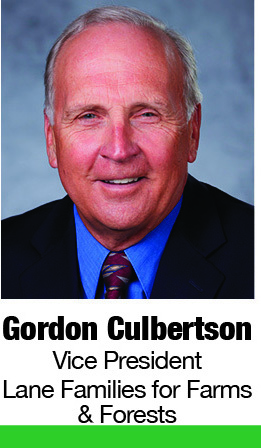
Gordon Culbertson is a small woodland owner and a founding member of Lane Families for Farms & Forests. He currently serves as the vice president.