
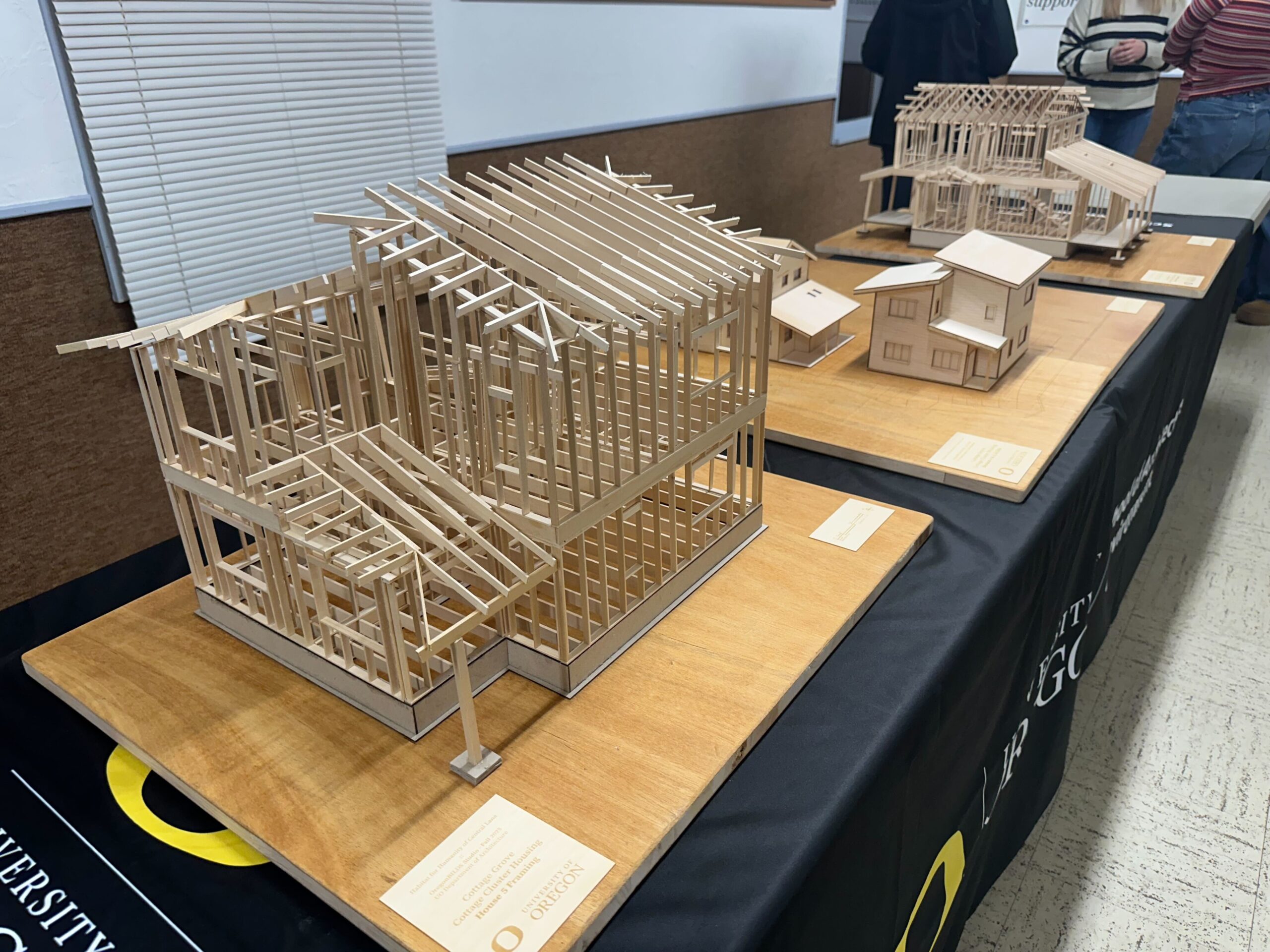
CRESWELL – University of Oregon students and Habitat for Humanity of Central Lane officials hosted a public meeting on March 4 at the Creswell Grange to share their designs for an affordable housing Cottage Cluster in Cottage Grove. Habitat is building the cluster of homes at 676 N. 11th St. and will contain five multi-generational homes with innovative elements such as thermal walls and attic spaces.
Students worked in a class studio for 10 weeks through the Oregon BILDS program at the university’s school of architecture. Under the instruction of Tom Hahn, an associate professor, Clay Neal, director of Oregon BILDS, and in relation to John Barnum, executive director of Habitat for Humanity of Central Lane, they designed two houses in the cluster.
BILDS stands for Building Integrated Livable Designs Sustainably, and focuses on small, affordable, efficient housing. Housing designs had to align with Habitat’s guidelines, one of which included an ADA-accessible first story, and with the City of Cottage Grove’s design limitations.
A total of 20 students, divided into two groups of 10, each with designated project managers, had to agree on the final design of a 1,500-square-foot house.
At the grange, the presenters hung blueprints on the walls and displayed popsicle-stick-type models. UO students and Habitat officials presented their collaborative project.
“My favorite part was getting to work with a team and seeing it all the way through,” said UO student Madison Coultrap. “I think it was really nice for our first project that we actually got to put into construction documents, so we’d actually think about how everything gets assembled…The hardest part is also coordinating with a team of 10,” she said.
Although students spent 10 weeks on the project, they sometimes averaged 40 hours of work a week. Coultrap said the studio class required 12 hours a week.
“There were weeks where people were doing the solid 12-plus a few hours here and there. There were weeks that it was like a full-time job with 40-hour weeks for sure,” she said. Review week for the project totaled 40 hours of work in two days, and building the models themselves took around 18 hours.
“We definitely have a lot of passion put into these homes. We’re really excited to see them being brought to life,” Coultrap said.
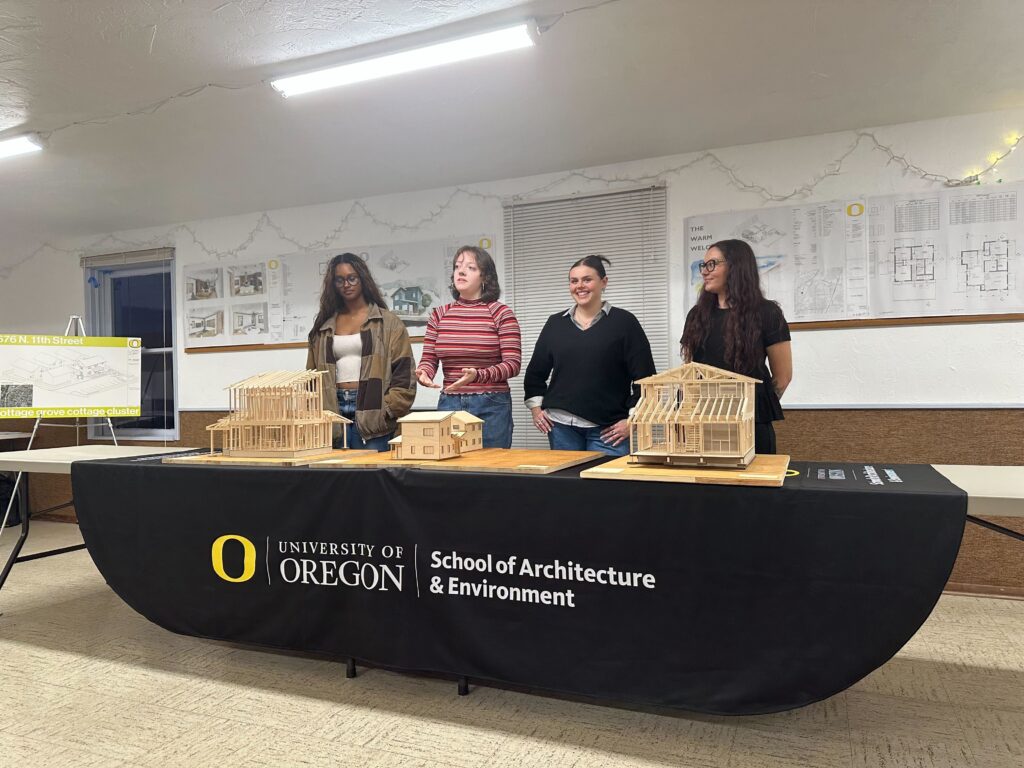
Sydney Simpkins, a UO student, worked on the foundation and floor plans for one of the houses. She said working on a street-facing house posed many privacy challenges. Her team tackled those challenges with the layout of windows and the separation of spaces.
“Maximizing the space and maximizing privacy on small lots was really important,” Simpkins said.
Another student, Jessica Strah, helped design the foundation and framing for one house.
“There was more of a desire to have a four-bedroom house to cater to multi-generational families, to provide them the space for that. With our design, we really wanted to focus on providing ample social and private space where a lot of people can live in this home, but still feel like they have privacy in their own space when they need time,” she said.
“These projects were incredible to do. They gave each of us a lot of experience that you don’t necessarily get when you’re in the actual design program for architecture,” said UO student Ivy Smith. She explained that most classes at school focus on architectural theory and history.
“What is incredible about the BILDS program, and this project specifically, is that you finally get the chance to take all of those concepts and ideas and the artistic side of things, and actually put them into a rationalized project. A lot of the time you don’t really get to do that until you’re already in the field, so this provides you the sort of opportunity that you wouldn’t necessarily get as any student in the program, and that, alone, in and of itself, is incredible,” Smith said.
“It’s really been wonderful to have the school of architecture to work with. It’s just a real treat,” Barnum said.
Neal said students will help break ground when construction begins, which is estimated for this spring.