
CRESWELL – With at least 13 Creswell families currently unhoused, and many more on the brink of losing utilities or housing, city leaders are exploring whether the Eugene-based transitional housing program, Everyone Village (EV), could be adapted to fit this small town’s needs.
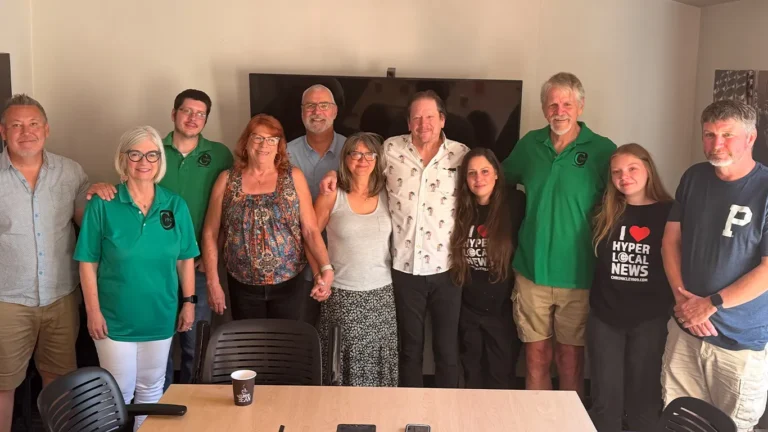
At Monday’s city council work session, councilors, staff, school district representatives, and a nearly full audience heard data on local family homelessness and a detailed presentation from Gabe Piechowicz, the founder and executive director of EV.
The conversation remained preliminary; no vote was taken. The city manager and mayor reiterated that they are not deciding to bring EV to Creswell, but rather asking whether a Creswell-specific version of the model is worth further study.
“The question is, could this transitional housing program be adapted to help the city of Creswell families? That’s the lens I’d like you to see this through,” City Manager Vincent Martorello asked of the council.

Creswell families in need
Kathryn Dumas, the Family Resource Center coordinator for the Creslane School District, provides basic-needs support and parenting education to families with children ages up to 18 living in Creswell.
“There is a lack of resources in Creswell,” Dumas said. “We have the Creswell Food Pantry, which is open once a week, and we have the Hope and Safety Alliance here. We have some disability services that are here. But as far as immediate basic needs support, we don’t have a lot of that here.”
Dumas presented the council with Creswell-specific and countywide data, arguing that these numbers reflect housing precarity and near‑homelessness among local families. The center has “exponentially grown” as local need has increased.
Over the past year, the center has served 629 children from Creswell families who need basic-needs support, up by 44 children from the prior year. Staff estimates roughly 90% of those families are just one missed paycheck away from eviction or utility shutoffs. Three Creswell families currently face imminent water shutoffs, and two face power cutoffs.
Dumas reported that of the 13 unhoused families living in Creswell, 10 have children enrolled in Creswell schools. Their situations range from motels and the Eugene Mission to RVs without permanent spots, and couch-surfing.
“This is a problem. We are seeing a lot of families struggling in this environment, and it’s not for lack of work,” Dumas said, adding that most parents are working, often in dual‑income or single‑mother households, yet remain unable to afford stable housing in Creswell’s limited market.
“Living in Creswell, our housing is not affordable. We have a small pocket of affordable housing that isn’t directly accessible … often, if families don’t have friends or relatives to stay with, they need to leave Creswell, and they don’t often return for that lack of affordable housing.”
The local picture sits within a larger crisis; Dumas noted that in January alone, Lane County recorded 193 evictions, a number expected to rise.
The ‘village’ model
Gabe Piechowicz, a former logger turned pastor, said EV grew out of his experience in west Eugene’s “RV land,” where he encountered crime, addiction, and extreme instability.
He pitched EV as a “blue-collar, accountability-first model.” Key elements include about 70 tiny homes for those moving from the street and 10 medical recuperation units for discharged hospital patients.
To participate, residents must complete chores, attend meetings, meet with a housing navigator, and actively work on a housing plan. They cannot use illegal drugs or alcohol on-site.
The village operates its own ecosystem, including a market garden, 11 commercial beehives, a flock of chickens, and an alternative recycling redemption center.
These enterprises create 17 paid part-time jobs on-site, plus more through the recycling operation, all filled by residents.
Concerns of cost
Councilors Staci Holt, Mark Kremer, and Alan Dukes, along with audience members, raised concerns about attracting unhoused people from other states and the financial burden they impose.
Piechowicz explained that EV leverages Team Oregon Build, where high school shop students build tiny homes using materials from Lowe’s at steep discounts.

Buying materials at retail would cost roughly $11,000 per unit. With the Lowe’s discount and student labor, costs drop to about $4,700 per unit. The village has attracted larger public investment, including a $2.5 million federal earmark for a “micro-village housing project” for households earning 0–30% of the area median income. EV starts with what very low‑income families can pay – roughly $300 per month – and works backward to design housing that suits that price.
Using HUD metrics, Piechowicz contrasted EV’s outcomes with those of typical shelters. HUD considers a program successful if 30% of participants exit into stable housing. While many local shelters report 28%-48% exit rates, EV reported a 70% exit rate in fiscal year 2025.
Local reactions, next steps
Multiple councilors and residents said they would consider only a version strictly limited to Creswell families.
“The only thing I would want to do is help Creswell families, Period. End of story,” Mayor Nick Smith said. “Be vetted. Families only. I want to keep the families together. I want to help the kids not feel bad when they go to school because they don’t have shoes or clothes, and they don’t have a warm place to stay. That’s going to get my heart every time.”
Creswell faces ongoing constraints around water and sewer capacity. Council President Alonzo Costilla asked how the city could realistically add new units that require utility hookups. Piechowicz acknowledged that without land and infrastructure, no project is possible.
Councilors directed staff to provide data on capital costs, annual operating costs (staffing, utilities, insurance, maintenance), and grant dependency. Councilor Staci Holt called proceeding without such numbers “fiscally irresponsible.”
Responding to Councilor Mark Kremer’s concern that the discussion was “out of left field,” Mayor Smith clarified: “It was part of Martorello’s hiring packet… It’s what we asked him to do… He’s doing his job.” Smith assured the council that “whatever the community wants is what this community gets.”
Staff is requested to bring back cost estimates, potential property options, and partner possibilities. Holt suggested the concept might ultimately need to go to the November general election ballot for voter decision.