
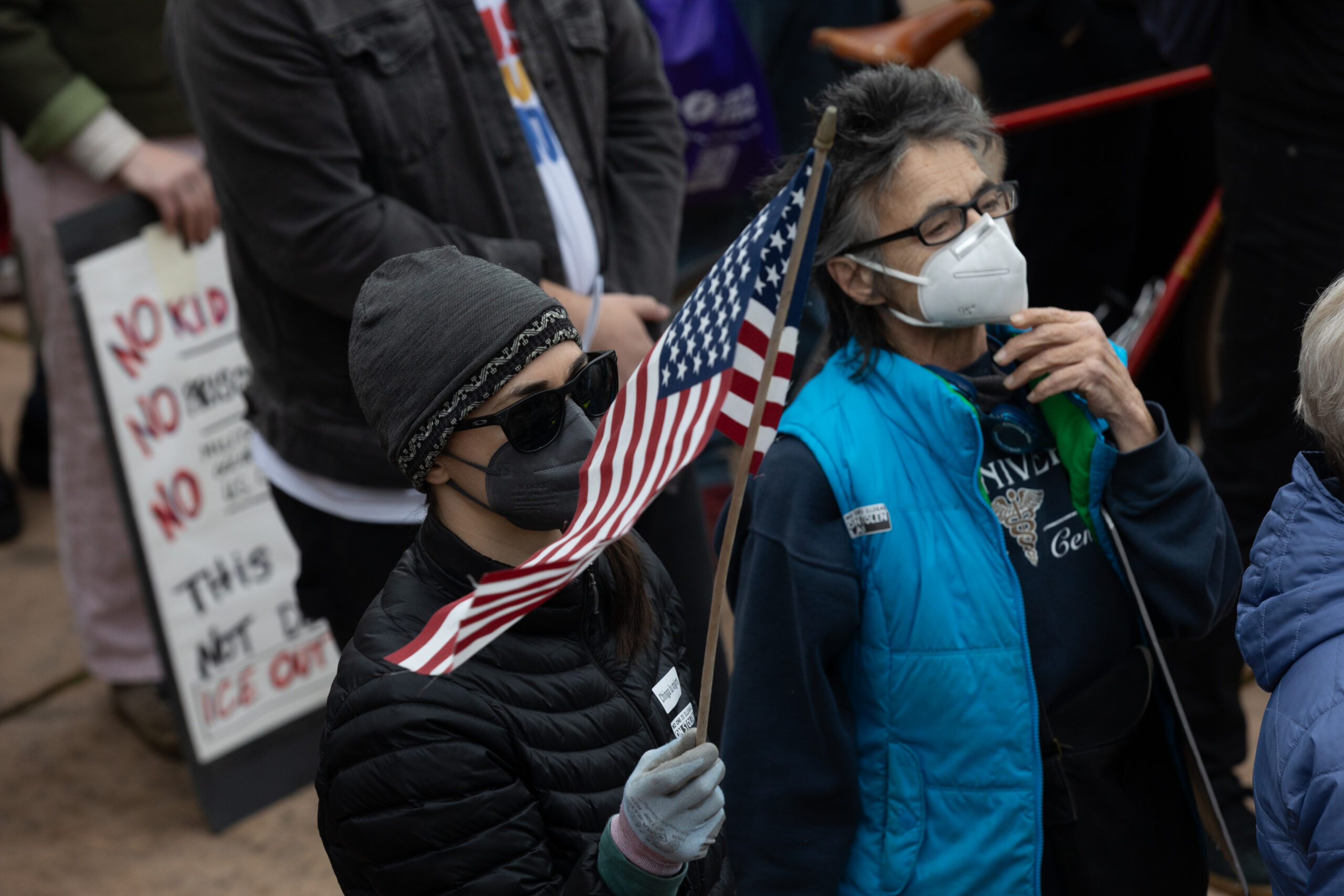
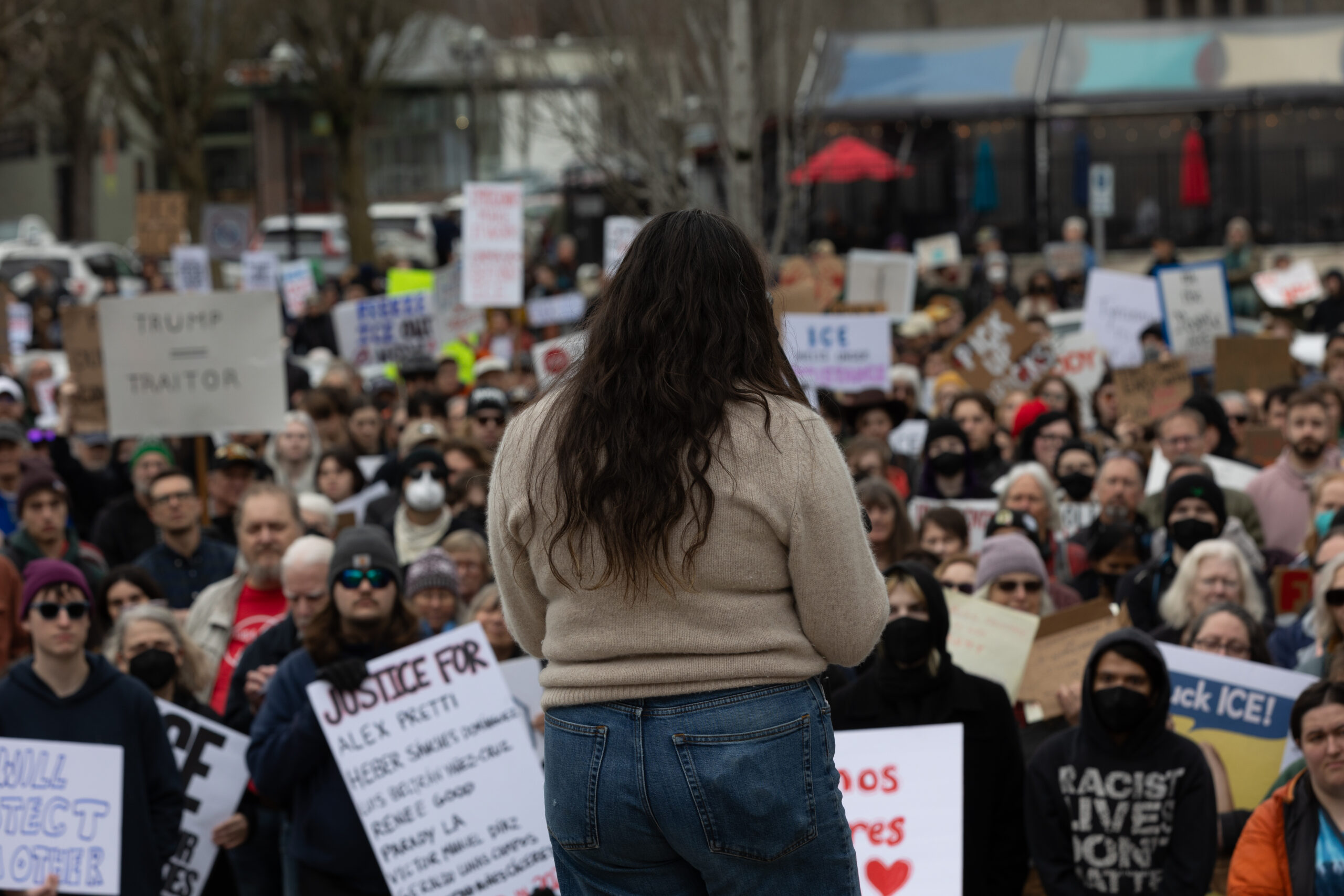
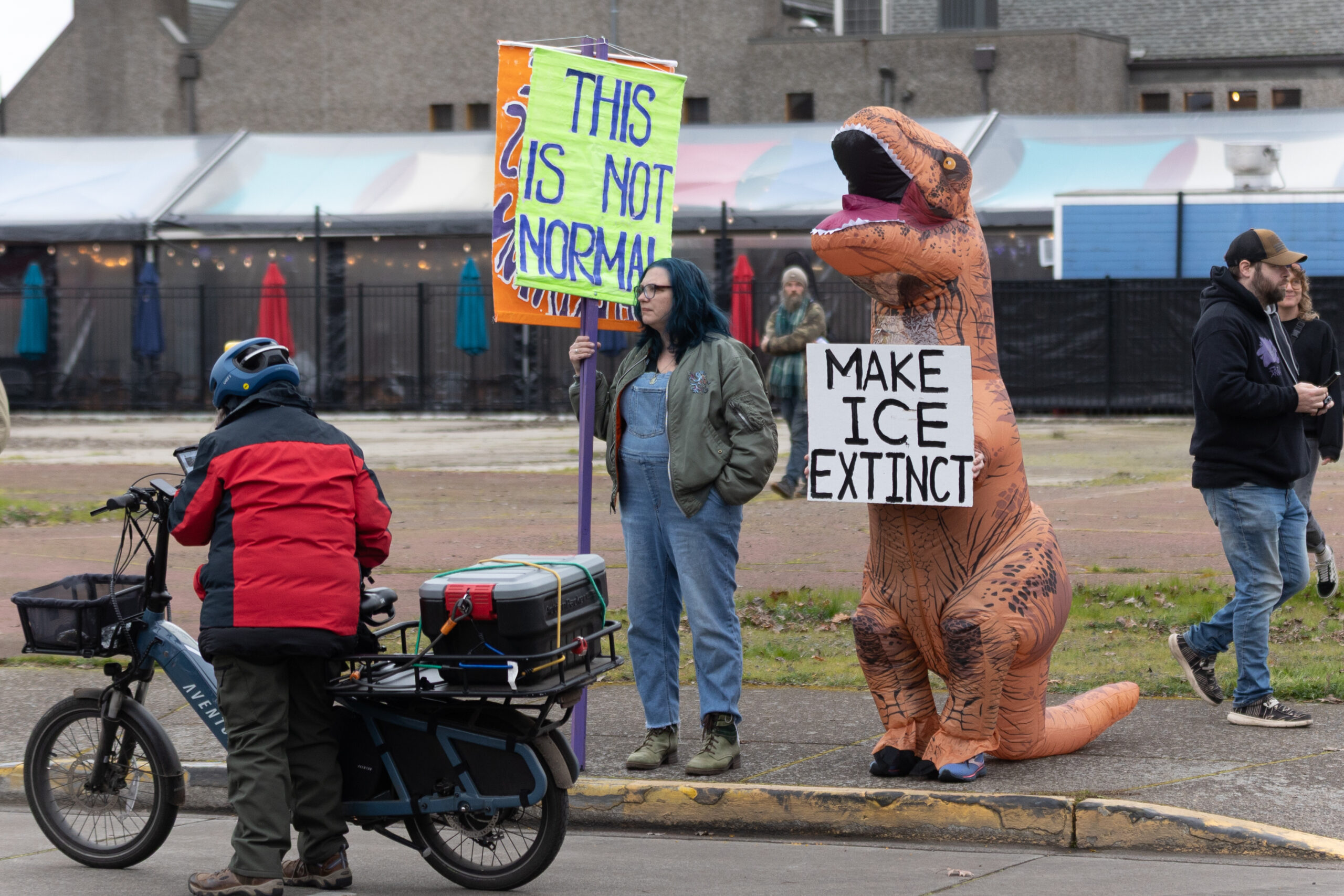
SPRINGFIELD – Hundreds of residents gathered peacefully outside Springfield City Hall on Friday, Jan. 30, to protest federal immigration enforcement and to express solidarity with fellow citizens in Minnesota.
“What are we doing here today? Minnesota called, and we answered,” said Rob Fisette of the Party for Socialism and Liberation at the start of the event.
This gathering was one of an estimated 300 protests held across the country that day. He said that more than 60 local businesses in our area had closed on Friday in solidarity.

“A national strike is a collective refusal – when working people, students, tenants, consumers, and communities coordinate to withhold what the machine needs to function: our labor, our money, our spending, our compliance,” said Latiffe Amado, a Rapid Response Lane County volunteer. Cottage Grove Friends of Democracy also hosted a similar rally the next day in Coiner Park.
These protests followed the historic citywide shutdown in Minneapolis, which saw over 100,000 participants and was organized by unions, faith groups, and community organizations. The protests were sparked by the death of Alex Pretti, a 37-year-old ICU nurse at a Veterans Affairs hospital, who was killed by federal agents in Minneapolis on Jan. 24.
Pretti was observing and filming federal agents conducting immigration enforcement actions when he attempted to help a woman who had been knocked down. Video evidence shows Pretti trying to assist her when federal agents tackled him to the ground. Although Pretti was legally licensed to carry a handgun and had one in his waistband, videos show the agents removing his gun from its holster before firing an estimated 10 shots into his back while he lay pinned on the ground by several agents.
Not what he fought for
Standing outside City Hall with a “Veterans against ICE” sign in hand, Frank Harper said he sees “history repeating itself.”
A Springfield resident and Vietnam veteran who has been protesting ICE since May, Harper said his activism stems from his service and his family’s military history.
He said he “took an oath to defend the Constitution, not any one president,” and sees echoes of past injustices – from his father’s trauma in World War II to the internment of Japanese Americans – in how ICE now targets people because of their skin color.
“My father, who’s a World War II veteran, was wounded four times – started off in North Africa and then into Italy, where he actually ran mules up into the Italian Alps. He would provide the mules with supplies and pack them with the casualties. His head was really messed up at that time – they used to call it ‘shell-shocked’ – and then I ended up in Vietnam,” Harper said. “What’s happening now is almost like history repeating itself,” Harper said. “For ICE and DHS to be targeting people because of the color of their skin, breaking down doors and things like that – it has to stop,” Harper said. “Look at the Japanese Americans who were interned – my best friend, his parents met at Poston – and we always talked, ‘Does history repeat itself?’ And that’s what’s happening now.”
The Poston War Relocation Center was the largest American concentration camp used to incarcerate over 18,000 Japanese Americans during World War II.
“It starts with pulling the masks off, being identified. When that happens, I think their brutalness will stop,” Harper said.
Harper said he worries Oregon could be next if federal authorities escalate enforcement here, but says he’ll keep showing up to support fellow protesters and community members facing that pressure.
“I don’t get myself in the thick of it – I don’t want to get knocked down or arrested – but I’ll just do my part to support people like Alex, who was a VA nurse killed for holding up his phone,” Harper said.
Power in protest
A longtime Springfield activist who has been protesting since the Vietnam era, Aloha Heart says she keeps showing up because protests “make a difference.”
“I’ve been out here (protesting) since Vietnam, and have probably been to hundreds of protests since,” Heart said. “I protest because it makes a difference. I know that we helped bring the Vietnam War to an end, we ended the draft, and we, the people of Springfield, stopped the ICE facility years ago from being able to rent rooms at the jail.”
In the summer of 2018, Springfield ended its 60-year-long agreement with ICE following public pressure at a city council meeting, where residents called for ICE to no longer be involved in the community. ICE, back then, approached the police department with a proposed agreement in 2012 to hold their detainees for $80 per bed, according to a KVAL report.
Heart said she wants city leaders to take a clear stand against ICE activity in Springfield.
“The City should come out with statements that support human dignity of all people and say that ‘we stand 100% for human rights, for civility, for love, compassion, and action,’” Heart said.
Kori Rodley, a city councilor, applauded protest participants at Monday’s meeting. She also commended the Springfield Police Department, “who have been providing extra support, mutual aid, de-escalation, and backup for the many events and activities that have been happening in Springfield and in our neighboring communities. A lot of these are just bubbling up sort of organically, and our officers at SPD have been amazing in terms of just being out there, supporting the community.”

In a statement issued on Tuesday to The Chronicle, Elyse Ditzel, public information officer with the city manager’s office, noted that “Springfield is committed to being a safe, welcoming community for all. We believe in a city where everyone is valued, treated with dignity, and able to participate fully in community life regardless of background, identity, or immigration status.
“Oregon state law (ORS 181A.820) makes clear that immigration enforcement is a federal responsibility. In alignment with this law, the Springfield Police Department does not engage in federal immigration enforcement or participate in ICE operations.
“We understand that federal immigration activity can cause fear and uncertainty. Our role as a local government is to remain transparent, uphold the law, and support the well-being of all our neighbors,” Ditzel said.
Armed in the parking lot
About an hour into the protest, across the street from City Hall in the empty parking lot, a confrontation unraveled between protesters and three or four counter‑protesters, some of whom were armed.
The crew, with an “I love ICE” sign, laid on their car horn during the rally, attracting the attention of the protestors from across the street, along with Springfield Police and Oregon State Troopers.
Tyler Alford, 20, of Springfield, dressed in camouflage and packing a Glock 17 and a Smith & Wesson AR-15 Rifle, said he came primarily to “show my Second Amendment right.”

“We’re not exactly protesting the ICE protest. We’re mainly out here for the Second Amendment and to put America first,” he told The Chronicle.
Protestors asked what practical purpose his weapons serve beyond asserting a right, and asked him to weigh the right to bear arms vs. the safety and intimidation effects of guns at protests.
“Just as (protestors) have the right to come out here and voice their voice … we have the same right to come out here and voice what we want, too,” he said.
When asked for his thoughts on the federal government justifying Alex Pretti’s murder because he was “carrying a gun” in the holster at the time of the confrontation, Alford said he didn’t want to speak to the subject as he “didn’t know too much about it.”
In verbal exchanges that ranged from calm to calamity, the pro-ICE group was challenged by protestors regarding people legally seeking asylum being detained at court, about US‑made weapons causing violence abroad that drives migration, and the moral issue of traumatizing a 5‑year‑old in detention.

Alford argued that parents who cross borders illegally “got (their children) into that mess” and should have made different choices.
“Suck it up and make your life better in your own country. Stay there and better yourself, build your own country up,” he said.
As conversations grew heated, protestors and anti-protestors were shoved, and someone ripped up the “I love ICE” sign. No injuries were reported.
Rally remarks
Organizers called for the abolition and full defunding of immigration enforcement, an expanded national strike, and community‑level structures to protect immigrants. They urged boycotts of Amazon, big chains like Walmart and Target, and encouraged people to shift spending to local businesses, form block networks and mutual‑aid systems, and treat “dignidad” (dignity) as the non‑negotiable baseline.
“Today we move from grief to power, from outrage to strategy, from witnessing to collective action, because dignidad – dignity – is not a slogan. Dignidad is the baseline,” Amado said.
“My dad always says this old proverb… ‘Una golondrina no hace verano’ – one swallow does not a summer make. But we are not one. We are thousands. We are hundreds of thousands. We are millions. We will be heard together,” speaker Kriscia Rivas said.
Alex de Luna, a 17‑year‑old Springfield student, said that fear must build courage.

“Springfield is being attacked while our community lives in constant anxiety… We’re not criminals. We’re not disposable. We are students, we are families, we are artists. We are Springfield,” de Luna said. “We will not be quiet – not just for those lost, but for those my generation might lose if we stay silent. My generation must speak up and get loud.”
June Fothergill, former pastor for Ebbert United Methodist Church in Springfield, said that the “actions of ICE and of this administration are not Christian … Discrimination because of color or nationality is not Christian. I hear Christ say, ‘Love your neighbors, give welcome to the stranger.’”
After the rally, there was a caravan to Eugene. While the Springfield event remained peaceful, demonstrations at the Federal Building in Eugene escalated that night, prompting the use of chemical deterrents, flash-bangs, and a “riot” declaration by Eugene Police.
Gov. Tina Kotek last week signed an executive order to establish an Interagency Council for Immigrant and Refugee Coordination in response to increasing federal immigration enforcement. This initiative, led by the Office of Immigrant and Refugee Advancement, aims to support these communities, ensure compliance with sanctuary laws, and address federal actions.
Oregon lawmakers are also proposing the Law Enforcement Visibility & Accountability Act, which would prohibit law enforcement officers from wearing masks, with exceptions for medical reasons and undercover work.
Sen. Ron Wyden, among others, is questioning an agreement among the IRS, Treasury, and DHS regarding the sharing of taxpayer data, citing concerns about privacy violations and the potential misuse of information against immigrant communities.