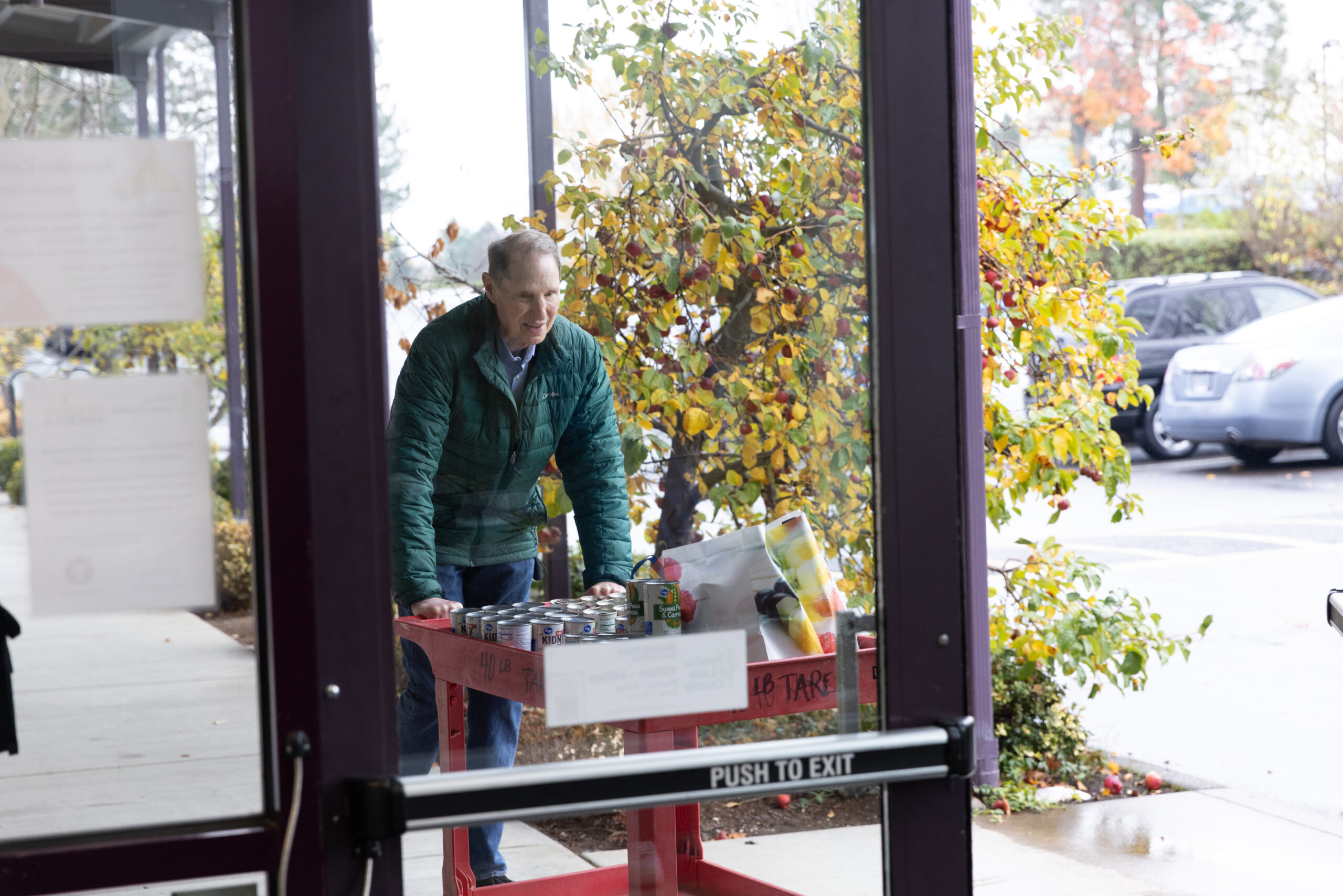
EUGENE – Food insecurity has been an ongoing issue in Lane County, with a recent spike in need for assistance, coupled with federal fund hang-ups. Last Thursday, U.S. Sen. Ron Wyden toured the Food for Lane County warehouse at 770 Bailey Hill Rd., donated groceries, and spoke on the subject.
“This food is going to get to folks,” Sen. Wyden said as he wheeled in a cart of canned goods through the front door of the warehouse.
Founded in 1984, FFLC serves over 80,000 people annually. The organization distributed 8.6 million pounds of food last year and is seeing significant demand, with 75,000 Lane County residents relying on the Supplemental Nutrition Assistance Program (SNAP), according to executive director Carolyn Stein.
“As you know, the past several weeks have been incredibly challenging for many of our neighbors. Changes to SNAP have already affected many people in our community,” Stein said. “In recent weeks, pantry visits have quadrupled, with many families turning to us.”
The warehouse features storage space for pallets of food, with many empty spots where pallets are usually stored.

“This is really the situation that we’re dealing with, which is that there simply is not enough food flowing,” Rebecca Sprinson, director of development and communications, said while guiding the tour. “I’d like to see every rack stacked three deep with pallets,” she said.
Funding holdups: A timeline
The U.S. Department of Agriculture announced it planned to freeze Supplemental Nutrition Assistance Program payments on Nov. 1, saying it could no longer continue funding the program due to the government shutdown.
On Nov. 3, the Administration announced that it will provide partial funding for SNAP in response to two court rulings that mandated the continuation of the food assistance program. Details regarding the amounts beneficiaries will receive and the timeline for when funds will be available were unclear, as the Administration attempted to undo court-authorized benefits that had already been disbursed.
On Nov. 5, the Governor declared a 60-day food security emergency and directed $5 million to Oregon’s statewide food bank network. Keeping the declaration active through December will allow people to have greater access to emergency food during the holiday season, Gov. Tina Kotek stated.
On Nov. 7, a federal court ordered the Administration to immediately release 100% of funding to pay for Supplemental SNAP benefits for all recipients nationwide. Gov. Tina Kotek said in a news release that the ODHS worked through the night to issue full November benefits the next morning.
By Nov. 8, Oregon families began accessing their full November SNAP benefits restored to their Oregon Trail Cards. All Oregonians receiving SNAP will now have their full monthly benefit available, regardless of their usual payment schedule, according to Kotek’s office.
Sen. Ron Wyden toured the Food For Lane County warehouse on Nov. 13 and held a press conference.
“The Administration’s decision to withhold food assistance from families in need was cruel and unlawful,” said Gov. Kotek. “Oregonians shouldn’t have to wait for a court order to get the help they qualify for and need. I’m grateful to the federal courts for upholding the law and to our state teams who worked through the night to make sure every Oregon family relying on SNAP could buy groceries today and through the weekend.”
SNAP is entirely federally funded and supports over one in six Oregonians, including children, working families, seniors, and people with disabilities. Each dollar spent in SNAP benefits generates an estimated $1.50 to $1.80 in local economic activity, resulting in a substantial impact of approximately $1.6 billion flowing into Oregon’s economy each year, according to Kotek’s office.
While the release of the federal funds brings relief, “the need remains immense. We are still expecting significant increases in requests for food assistance due to new restrictions on SNAP that went into effect this month as a result of HR 1,” Stein wrote in a newsletter. “Additionally, we anticipate a dramatic drop-off of USDA-supplied food to Food for Lane County in early 2026.”
Efforts continue at Food for Lane County
To battle the growing demand, Stein said FFLC has purchased “several truckloads of food, with more on the way,” she said. They are also adding 11 new mobile pantry pop-ups for the holiday season.

Wyden noted the need for more food and political action to reverse SNAP cuts, highlighting the impact on vulnerable populations and local economies.
“Food in America should never be used as a political weapon. Sadly, hunger never takes a day off,” Wyden said. “I’m going to do everything I can to reverse that damage, because we’re seeing, particularly, for seniors, for young people, for disabled folks, when they can’t get good food, they’re going to get sick. And the reality is, it may cost a little bit for the food, but the illnesses are so much more expensive,” he said.

Wyden also said every food bank he knows of needs more food “because the demand is so enormous.”
“The first thing I want you to know is I’m going to do everything I can after I go to get some people to help me fill those racks, because that’s hugely important,” Sen. Wyden said.
Stein said folks have stepped up to donate funds, host food drives, and support FFLC’s work.
One community member in attendance at the press conference was Jessica Chinitz-Mital, a junior at South Eugene High School. Chinitz-Mital volunteers at the warehouse where she helps sort food. She has also been donating to the organization through plant sales for the past five years.
“I wanted to do something about hunger in Oregon and Lane County,” she said.
During the COVID-19 pandemic, Chinitz-Mital and her father started growing around 300 plant starts during the spring. When the plants are ready, they sell them to neighbors and friends and donate all of the proceeds to FFLC. Last year, the duo raised over $1,000 for the organization.