Interview with Emerald Art Center artist Robyn Drake
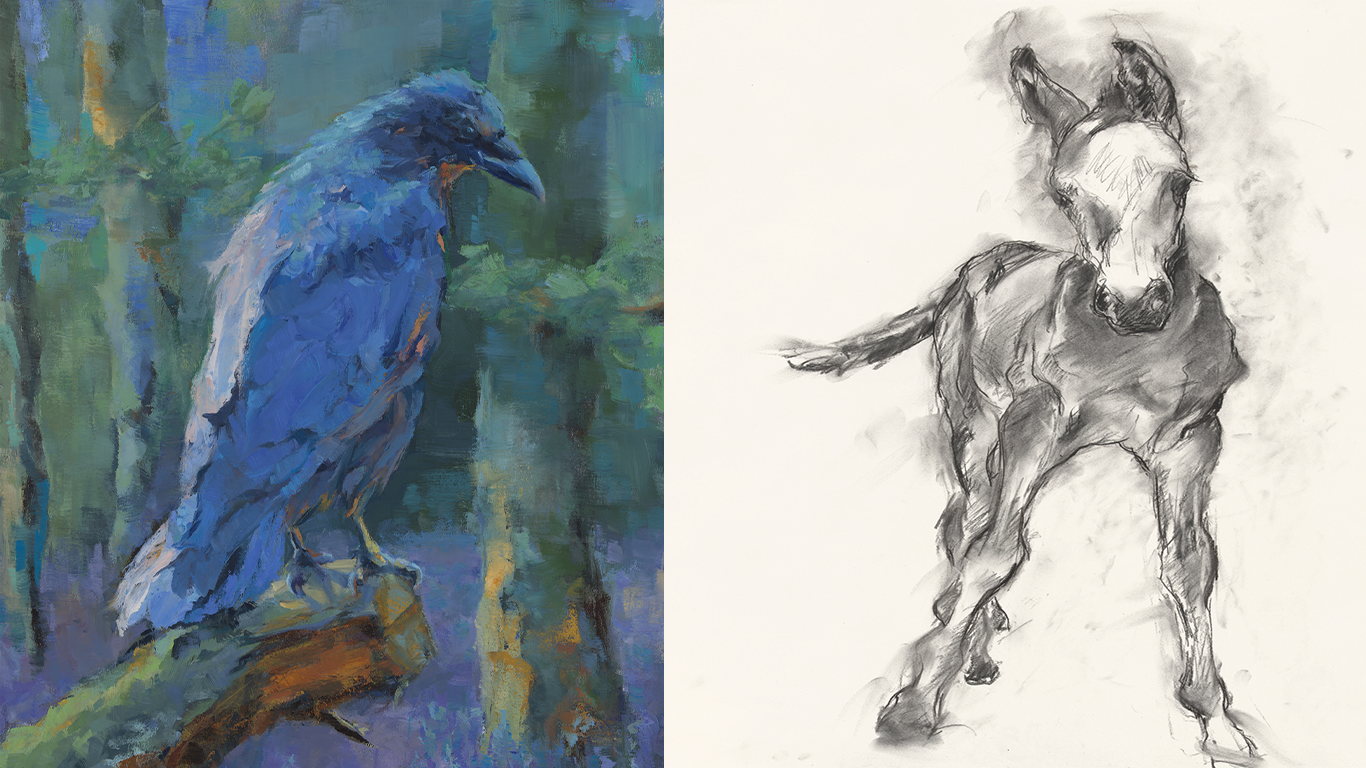
SPRINGFIELD — The Emerald Art Center is pleased to present “Untamed and Indomitable,” an exhibition of recent works by California-based painter Robyn Drake, on view now through Sept. 26. A public reception will be held on Friday, Sept. 12, during Springfield’s monthly 2nd Friday Art Walk. In conjunction with the exhibition, Drake will also lead an alla prima floral painting workshop on Friday, Sept. 26, from noon-4 p.m.

Q&A with the artist
Hudgins, EAC director: When you were young, did you imagine a life of art?
I think I always knew I would make things. As a child growing up on a ranch in Iowa, I was surrounded by working hands—people who built, repaired, and shaped the world around them out of sheer practicality and grit. There weren’t people you could pay to solve all your problems—you had to figure it out yourself. We were capable and resourceful, taught to work with what we had. That way of being—pragmatic, observant, and hands-on—extended into the process of making art for me.
I think you have to have a lot of grit to be an artist. You have to refuse to give up, to not surrender to an easier life. Growing up on a ranch and farm prepared me for that. Life there was unforgiving, and in that way, it shaped me to walk this path—untamed, indomitable, determined, and high-risk tolerant.
My father was a talented illustrator, though he never pursued it professionally. After dinner, I would often ask him to draw a horse for me, and he’d sketch one on a napkin or scrap of paper. I’d take it into the living room and copy it, again and again. Those are some of my earliest memories of making art.
I took painting and piano lessons with a nun in a nearby town—I don’t remember for how long, but I still remember her name: Cecilia Elsgroth. I must’ve been about seven or eight years old. I remember her aloofness, discipline, and the smell of the oil paint studio—working on paintings while she taught piano lessons in the next room. It seemed like a natural environment to me.
I didn’t necessarily imagine a career in art—there wasn’t a clear path for that—but I do remember a moment in junior high art class that stayed with me. We were asked to draw one of our classmates from life, and I remember the surprise on the teacher’s face when she saw my drawing. In that moment, I saw something in her expression—astonishment, maybe recognition—that told me my hands and eyes worked together in a way that wasn’t typical. Even back then, art was how I processed the world. It still is. Dropping into the creative part of my mind made the world so much bigger than the rural community that comprised my outer world.
What was your reaction to your first sale?
Oddly, it was a mix of pride, shock, and certainty. It was a pastel portrait of John Canarina, the conductor of the Drake Symphony Orchestra and a music professor at the university. My painting professor, Jules Kirschenbaum, told him to buy it. Jules was an intimidating figure—brilliant, distant, a little terrifying—and to receive any kind of praise from him felt like being seen by a god. The fact that he not only acknowledged the work but orchestrated its sale gave me a kind of strange validation. Canarina paid me $100 for it. I remember feeling stunned—but also quietly certain that this was the beginning of something real.
Your artworks are so varied. Do you have a favorite subject that you always return to?
Yes—though it shifts over time, depending on where I am in my process. My first love is figure painting, and that includes the horses. I’m drawn to movement, psychology, and emotional expressionism. Horses in particular have been a lifelong presence, both in my daily life and in my work. They embody both muscle and metaphor—symbols of power, nobility, loyalty, fragility, motion, danger, and silence.
I also return to seascapes and still lifes, often as a formal exercise or a kind of reset. They offer a different kind of challenge and sometimes a break from the intensity of figurative work. The ocean, like the horse, is an untamable force. It asks us to confront our own fragility, vulnerability, and smallness. It’s vast and unforgiving, a place where control gives way to awe.
These recurring forms—figures and sea—let me explore the themes that remain central in my work: vulnerability and resilience. Whether I’m working abstractly or more representationally, those emotional undercurrents are always present.
Tell me more about your wax medium.
I work with an oil-and-beeswax emulsion that I started making back in the ’90s. I was inspired by reading about ancient Greek encaustic paintings—some of which have survived for millennia, even under water. I didn’t have the patience or setup for true encaustic, so I began experimenting with oil-and-wax emulsion recipes until I found one that worked for me. The resulting medium gives a crisp, bright refraction that I loved, especially for floral still lifes. Paintings I made with it in the ’90s are still vibrant, so the recipe has proven to be remarkably resilient.
It’s designed to be used with oil paint, and I’m also starting to experiment with it in combination with oil pastels. It allows me to build surface and texture in a way that’s very different from traditional alla prima techniques—I make my own medium for that as well. Depending on the wax content, the surface can be etched, layered, and excavated. It holds memory.
I’ve explored a lot of different mediums over the years—acrylic, gouache, liquid charcoal. But I’m especially drawn to those that invite revision and erasure. There’s something intimate about working into a surface over time, letting old marks show through like palimpsests. It mimics how we experience emotion and memory—not in clean layers, but as sediment: fractured, buried, revisited.fractured, buried, revisited.