
This article was updated on Aug. 1 to issue corrections and make clarifications.
SPRINGFIELD – Mayor Sean VanGordon last week discussed Springfield’s financial future with community members during a Springfield Chamber Roundtable event. The conversation comes on the heels of a recent report that outlined a long-term structural imbalance and a short-term budget deficit within the City’s General Fund.
This imbalance has been attributed mainly to decades of limited property tax growth due to state measures, according to the report published by ECO Northwest, an independent economics and policy consulting firm. At the same time, the current deficit reflects the impacts of inflation and broader economic pressures across various levels of government.
Springfield’s projected budget shortfall is an estimated $4.5 million by fiscal year 2027–28.
Without any action, essential public services are at risk. The Task Force used a target of $4.5 million to counteract the shortfall, and what started as a list of 56 recommendations was narrowed down to nine.
Key recommendations include adjusting public safety levies, evaluating a payroll tax, reassessing administrative cost allocations, reducing library service levels, and pursuing targeted economic development strategies.
The Task Force includes 12 local community leaders, including Joy Pendowski of Chambers Construction, community volunteer Aimee Yogi, Cameron Krauss of Swanson Group, Springfield Chamber CEO Vonnie Mikkelsen, and Alicia Beymer of PeaceHealth, among others.
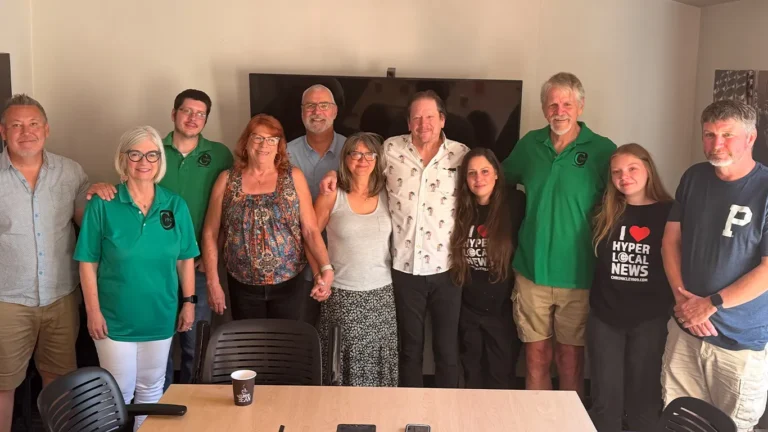
On July 22, VanGordon brought Springfield’s business community together for an open conversation about the proposals.
Library reduction
The task force recommended that the City reduce the library budget by $500,000.

“Many people came in and said, ‘Let’s get rid of the library. That’s $2.5 million, let’s just do that,’” said Anne Marie Levis, a consultant who helped direct the Task Force. “Through the process, people really understood the values, the things that the library brings to us, but they thought that it could be reduced by $500,000. That got us part of the way to our charge, which essentially is $4.5 million,” she said.
Betty Goracke Olguin, who serves on the Springfield Library Foundation, noted in a Chronicle interview that the 22% budget decrease starting in July 2026 could lead to diminished library services, halted book budgets, reduced operating hours, and the elimination of three staff positions.
“We are still advocating City Council look at other options like increasing the Task Force’s proposed payroll tax or any of the other raise revenue options,” Olguin said.
Tax increase
The task force recommended that the City implement a shared employee and employer payroll tax to generate $2.3 million.
Levis said the tax would be “small, with guardrails,” at about .1% The tax would apply to private, public, and nonprofit employers, and excludes Social Security and Medicare income.
“For years, this community has told us that we understand we need more revenue, but we’re worried about seniors,” VanGordon said. “Find a broader way to tax, extend the tax base, bring more people in to pay for proper services ….”
For employers with a $500k payroll, it would equate to $50 a year, or around $1 per week.
Police and fire safety levy
The task force recommended that the City increase levies to cover the costs outlined in the ballot for Police and Fire & Life Safety levies to generate $1.3 million.
“Most of our money is (spent) on three things: public works, public safety, and police and fire,” VanGordon said, noting that this particular levy has been in place since 2005. Levis said that not all costs were accounted for when the levy was first established.

The current rate is $0.38 per $1,000 of assessed value, generating approximately $2 million annually, an amount that does not fully cover the cost of operating a fifth engine crew — an estimated $2.7 million in FY26.
Springfield City Council has since approved the levy to be placed on the November ballot for voters to decide.
He said that the council chose to raise the cost of the levy, “so that we go back to that deal we had started in the community 20 years ago … that the levy should fund the full (fire) station,” VanGordon said. “And that way, we can essentially free up resources in the General Fund … If we as an elected body are going to the public and asking you to fund a specific service, we need to bring in the full cost of that specific service so that we can better balance the city finances.”
Other recommendations
The Task Force also made recommendations aimed at improving health and safety, which may or may not have a fiscal impact. These include implementing traffic cameras, with any net revenue directed toward public safety needs, and decreasing police overtime.
In a balancing act, one audience member asked how the City plans to “have a conversation about development and deficit in the same sentence.”
Levi said it all comes down to investment in the long run.
“As we talk about (developing) Gateway and even as we’re looking at what’s happening in Glenwood, you can’t do that by magic. I wish I could, but you can’t. There does have to be investment, and so that’s how we need to be thinking. How do we solve this for the long term, not just for this full income?” she said.
VanGordon emphasized many times that this whole process is still in the “idea stage.”
“What I’m telling you today, we’re 50% of the way to understanding … I’m listening to what my constituents have to say about how we move forward and what we should do … We are getting out in front of you while it’s in the idea stage to give people a chance to join the conversation,” the mayor said.
Read the full report: springfield-or.gov/mayors-fiscal-stability-task-force/