“Summertime and the living is easy.”
Or is it? So much to do, so little …
I’ve been thinking a lot about time lately: there’s never enough of it; it flies by too quickly; it drags interminably; the present moment is precious – but almost impossible to savor fully before it dissolves and slips into the past.
It’s like time – or at least our sense of it – is elastic. We’ve all experienced this, right? When we’re kids, the minutes drag, the school year feels endless – as does the time (doubly endless) between holidays or birthdays. As we age, it feels like time speeds up: no matter how unending some days feel, we’re constantly aware of the internal voice whispering that we’re falling behind. There’s never enough time to do all the things we want or need to do – or to say all that we need to say.
The pace of contemporary culture exacerbates this sense of urgency. From climate change to hitting purchase before the sale countdown clock runs out, we are constantly urged to think days, months, or years ahead. Are you ready for back-to-school? Christmas? retirement?
As the pressure of urgency mounts, we become correspondingly less patient.
We want results. We want our order. We want things fixed. We want it now.
Just writing this makes me feel anxious and tired. And I know that feeling is not unique to me.
I was acutely conscious of this time-and-(im)patience conundrum as I was on the phone the other morning with a small woodland owner lamenting how “behind” she and her family are in terms of actively caring for their property. I was wearing my Oregon Tree Farm System “hat” for this conversation. For background, OTFS is part of the national American Tree Farm System. Both nationally and locally, “Tree Farm” isn’t really about “farming” trees; it’s about supporting private landowners in managing their land sustainably, in accordance with international sustainability standards. Both organizations are under the larger umbrella of the American Forest Foundation, whose mission “is to deliver meaningful conservation impact through the empowerment of family forest owners.” All three are worth a Google to learn more.
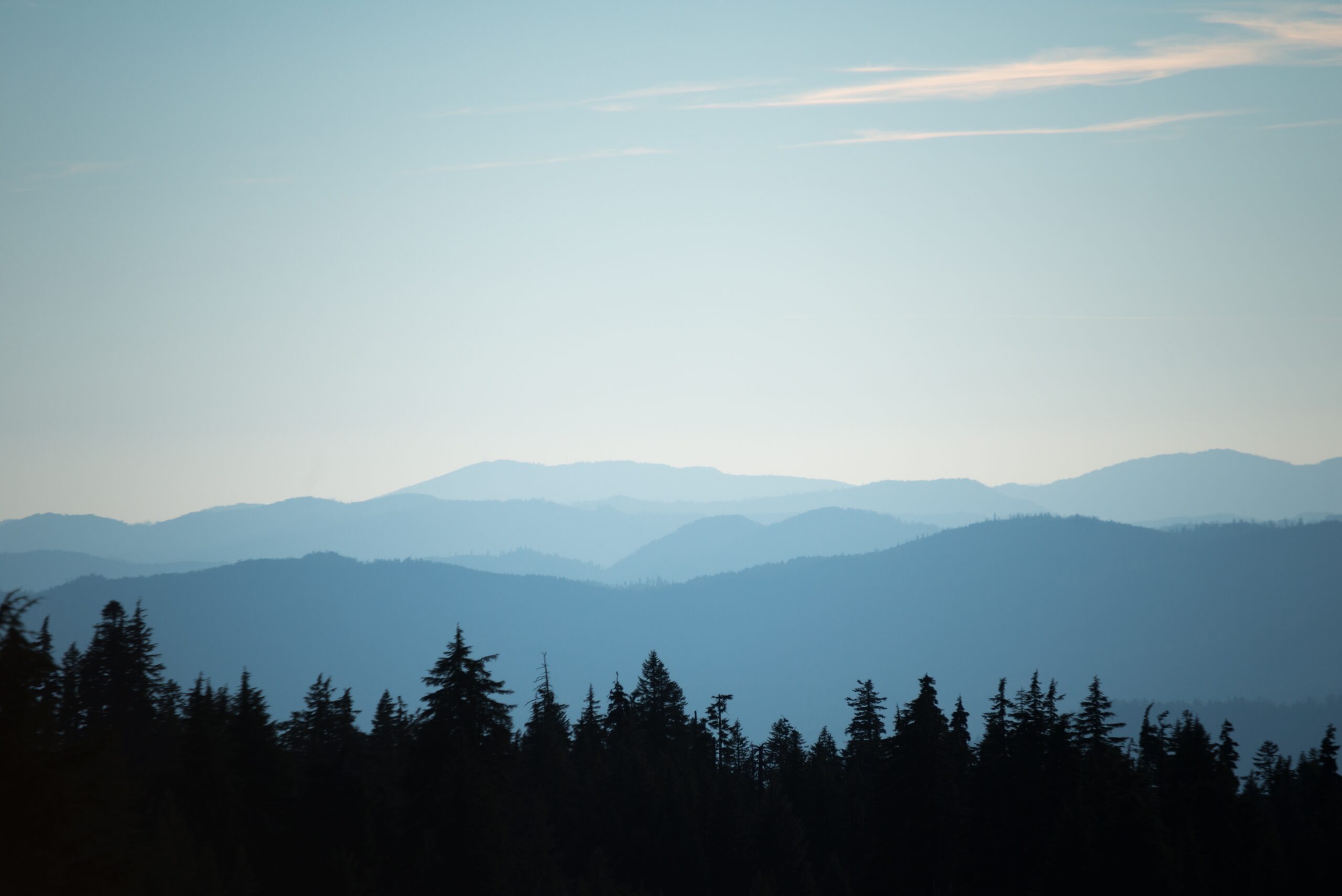
Step one toward empowering a small landowner is to de-fang the guilt that comes from the reality that to-do lists are always longer than there are hours in the day. Step two is to help them take a step back from our culturally nurtured impatience to remember that our human experience of time and its pressures is not how our forests or the natural world experience time. Although sunrises and sunsets and seasons pass for all of us, a tree, a forest, a landscape experiences that passage differently. What seems like eons to us is really a blink of the cosmic eye to an Ancient Bristlecone Pine or one of the volcanoes of the Cascades.
Trees grow by increments. What we don’t accomplish this week, this month, or this year can be done next week, next month, or next year. We do what we can – and then we move on to the next task. What matters most is that we take the time to be intentional, to consider our management objectives, to determine and prioritize the steps to reach those objectives – and then to be counter-culturally patient as we await results from our efforts.
T and I are reminded both of the elasticity of time and of our own impatience every day. It feels like forever since the fire, but in forest time it just happened. Actually, even in calendar time it was barely six years ago. Trained foresters look at our young forest and see a forest that’s recovering well. When we look out at our slowly recovering woodland, we see everything we have yet to do. We worry incessantly that we haven’t done something well enough and that is why our trees aren’t taller. Products of our culture, we are impatient and time-stressed.
In Braiding Sweetgrass, Robin Wall Kimmerer notes: “The land is the real teacher.” We aren’t trained in forest-time or forest-seeing – and while our forest is trying to teach us, we’re painfully slow learners. But we’re trying. And maybe, even if we don’t fully believe it, there really is time.
Kate and her wife, Theresa, are small woodland owners up the McKenzie, in the Holiday Farm Fire footprint. Their property is OTFS-certified. They are both members of Lane Families for Farms & Forests.