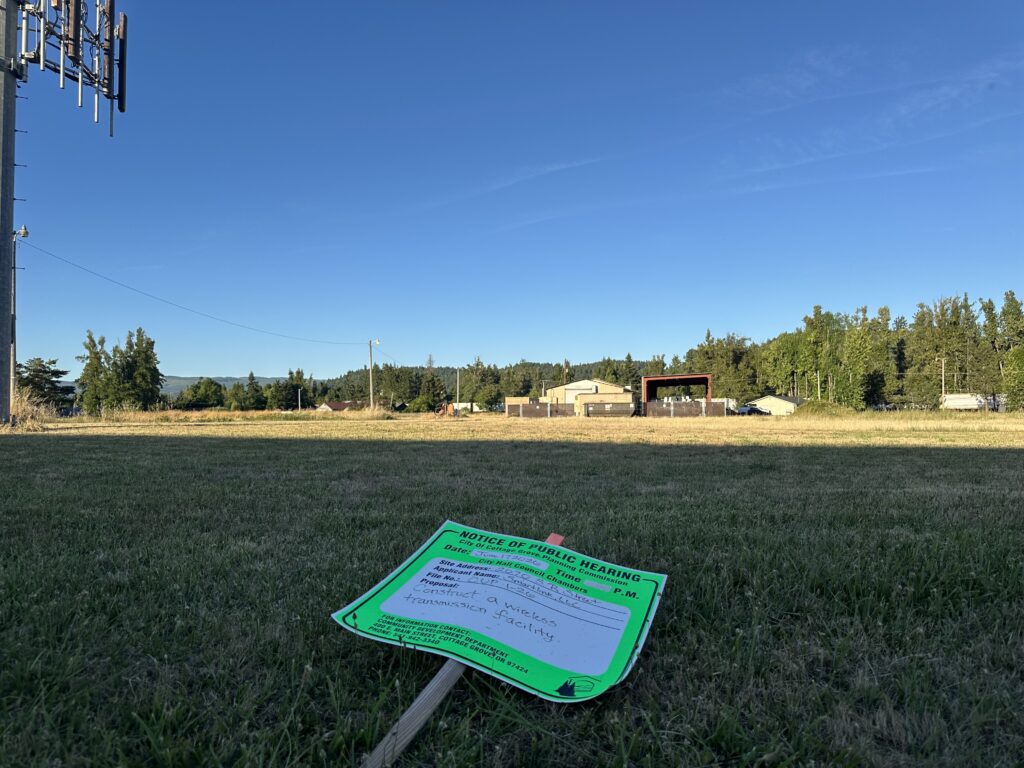
COTTAGE GROVE – Last Wednesday, the idea of a 100-foot cell tower was floated before the Cottage Grove Planning Commission during a public hearing and raised community concerns.
The application was submitted on April 21 by Smartlink LLC, and the city released a staff report on May 22. According to the 168-page report, the application is to construct a wireless transmission facility (WTF) at 2070 S. R Street.
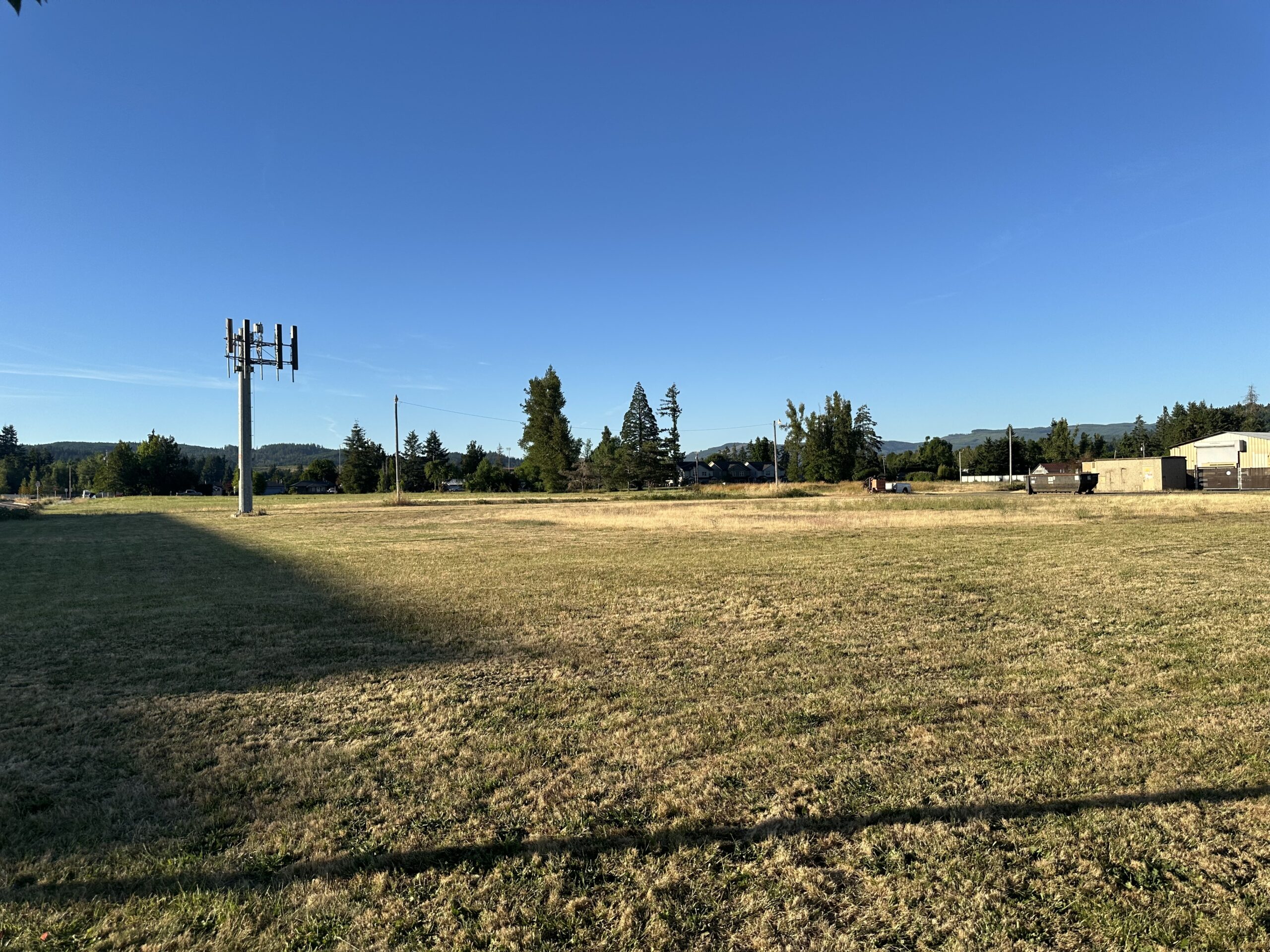
The WTF will occupy a 50-by-50-foot space located approximately 100 feet away from S. R Street. The applicant proposes a 100-foot-tall tower with a 6-foot lightning rod at the top, in a neutral gray color.
Neighbors within 300 feet of the area were notified on Dec. 21 by a letter from Dan Dutton, a Smartlink LLC worker and consultant for Verizon Wireless. The notice was for a community meeting on Jan. 6 regarding the cell tower.
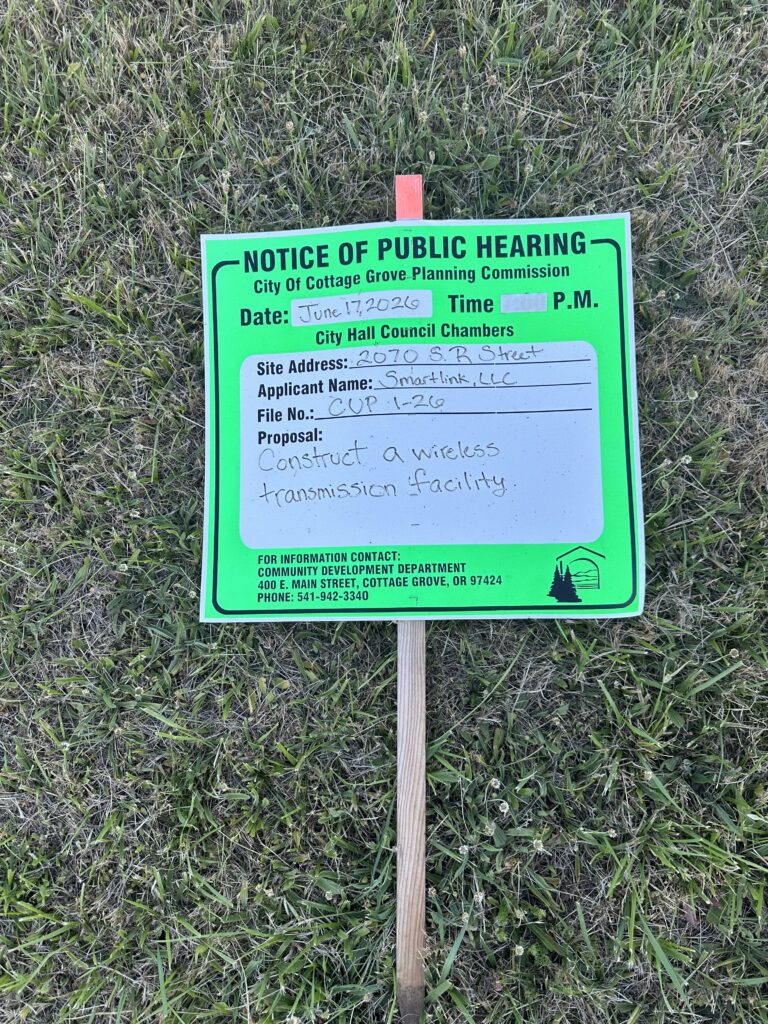
According to Dutton, about 12-14 people showed up to the meeting, with eight using a sign-in sheet. Leni Crow, the city’s senior planner, relayed information from the applicant to the commission and said 44 residences were identified as directly adjacent to the industrial zone.
The neighborhood meeting consisted of Dutton discussing the proposal and attendees asking various questions, such as why property values have decreased and whether the tower has 5G.
During last week’s meeting, a handful of folks spoke up in opposition to the proposal. Cottage Grove resident Cynthia Hill questioned the cell tower’s proximity to the high school and the Environmental Protection Agency’s suggestion to keep a safe distance from emissions.
According to the EPA, electronic devices that transmit information through the air are everywhere, including Wi-Fi, cell phones, and other networks. These devices use radiofrequency (RF) energy, a type of non-ionizing radiation, to send and receive information.
Non-ionizing radiation is not strong enough to directly affect the structure of atoms or damage DNA; however, it can cause atoms to vibrate, which can heat them up. Cell phone towers may broadcast higher levels of RF.
The EPA notes that only large, high-power transmitters, such as commercial long-distance towers, can produce hazardous RF levels on the ground and does not set a single fixed “safe boundary” for all wireless transmission facilities. These sites have warning signs and restricted access to prevent public exposure.
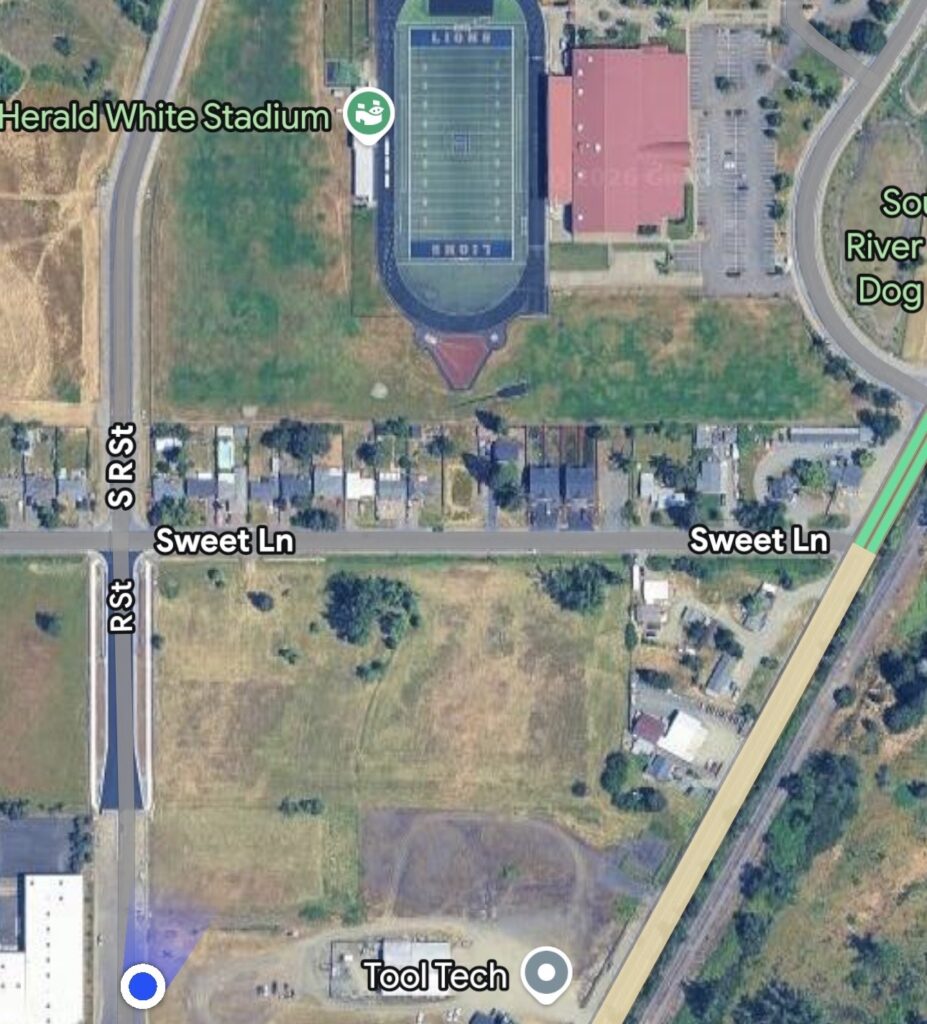
Crow said the homes directly west of the proposed project are between 1,400 and 1,700 feet from the proposed location. The other residences are located directly north along Sweet Lane. The applicant stated that the nearest dwelling along Sweet Lane is located 680 feet due north of the proposed facility. The tower would be placed in a field approximately half a mile away from the Cottage Grove High School property.
Patrick Cartwright is the owner of Coast Fork Classics, an auto restoration shop located in the industrial park where the proposed tower will go up. Cartwright and Kevin Solonsky, another business owner, are leading a community opposition.
“It’s approximately 640 feet from the residential houses. More importantly, it’s 1,032 feet from the high school property,” Cartwright said to the council. He also raised concerns about lawsuits against the Federal Communications Commission for failing to update RF radiation levels.
In the 2021 case of Environmental Health Trust et al. v. FCC, the D.C. Circuit Court criticized the FCC’s 2019 decision to keep its 1996 RF exposure limits. The court found the FCC failed to address thousands of pages of scientific evidence showing potential harm from RF radiation at levels below current limits, including non-thermal effects, impacts on children, wildlife, and reproduction. The ruling ordered the FCC to provide a reasoned record explaining why it ignored this evidence.
“It’s been proven to cause harm, and especially to young children and kids in school zones,” Cartwright said.
Other comments mentioned the potential depreciation of property values.
“If the application is approved, the value of my property will be significantly devalued, if not made worthless, and I do not believe that I will be able to develop the property because of the WTF that would tower over my property,” Solonsky wrote in a letter to the city. “If the WTF is approved, my property will become useless.”
Some public testimony had already been considered by staff, and Crow responded to the concerns raised. A petition was received on May 19 by the City, titled “Petition From Businesses in the Cottage Grove Industrial Park Opposing the Cell Phone Tower Proposed by Starlink LLC and Verizon Wireless to be Located in the Cottage Grove Industrial Park.”
“The public comment did not provide substantial proof as to the tangible financial impacts a wireless transmission facility would have on their properties, and they did not provide substantial proof that customers are less likely to do business in the industrial park,” Crow said.
Despite community concerns, Crow said the proposal meets visual and noise requirements and is sited where that has the least impact on residents.
“At this point, staff does recommend approval given the meeting of the criteria as proposed,” Crow said.
Craig Brunkenhoefer, a representative of the applicant, had the opportunity to speak last before the public hearing closed. He acknowledged the issues raised.
“I would ask that I get a little bit more time to be able to address all these, I think they’re important,” he said.
Since the tower meets all of the requirements, Brunkenhoefer encouraged the council to approve the proposal.
The council said it wanted more information. Commissioner David Christopher was interested in hearing more about other locations where the tower could be installed, noting that Lane County had previously denied Verizon’s proposal for a WTF on London Road.
The hearing will continue on July 15 at 6 p.m.