LANE COUNTY – Officials are urging residents to prepare for wildfire season, after outlook maps predict a greater-than-usual likelihood of significant wildfires for much of the state as early as next month.
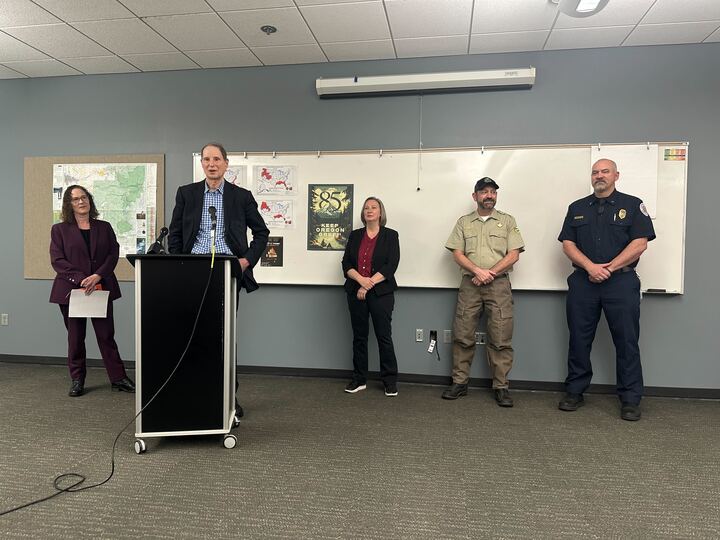
“We’re looking at a brutal summer. I don’t know any other way to describe it than that,” said U.S. Sen. Ron Wyden during a news conference in Springfield last week.
Based on the National Interagency Fire Center (NIFC) map for June, the northern and Inland Northwest portions of Oregon are highlighted in red – indicating significant fire risk – including Parts of the northern Willamette Valley and the coastal range.
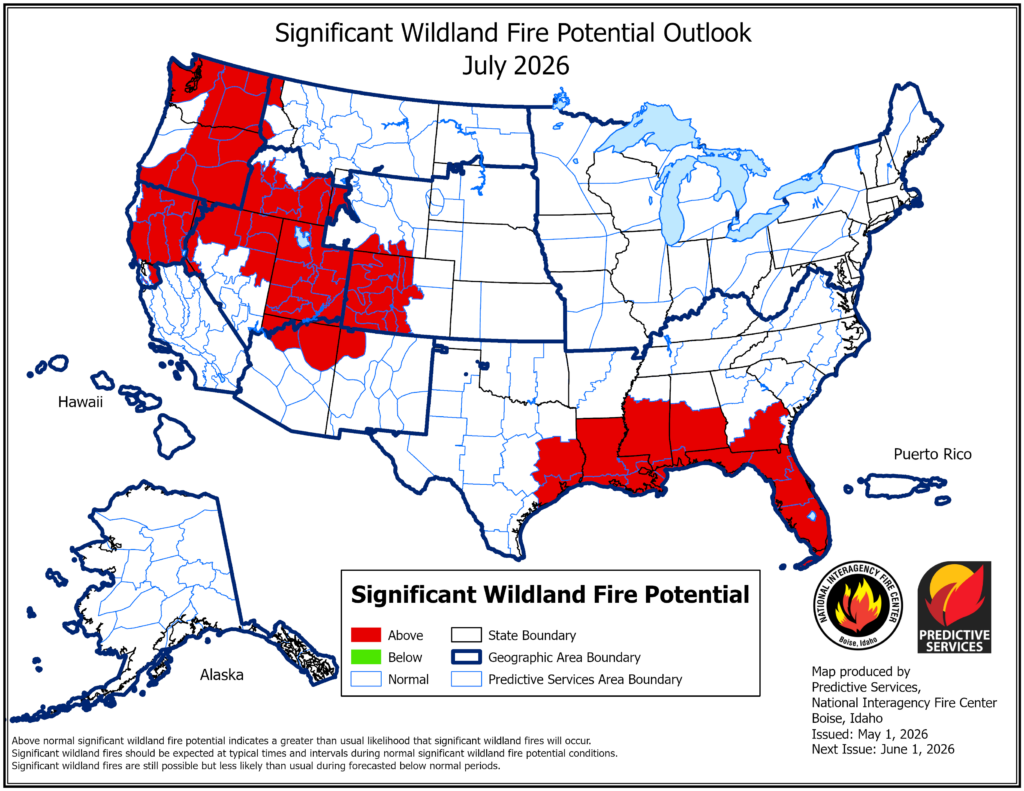
While the June map was concentrated in the north, the July map shows that the vast majority of Oregon is now in the red, with only a small pocket in the southeast remaining in the non-risk category.
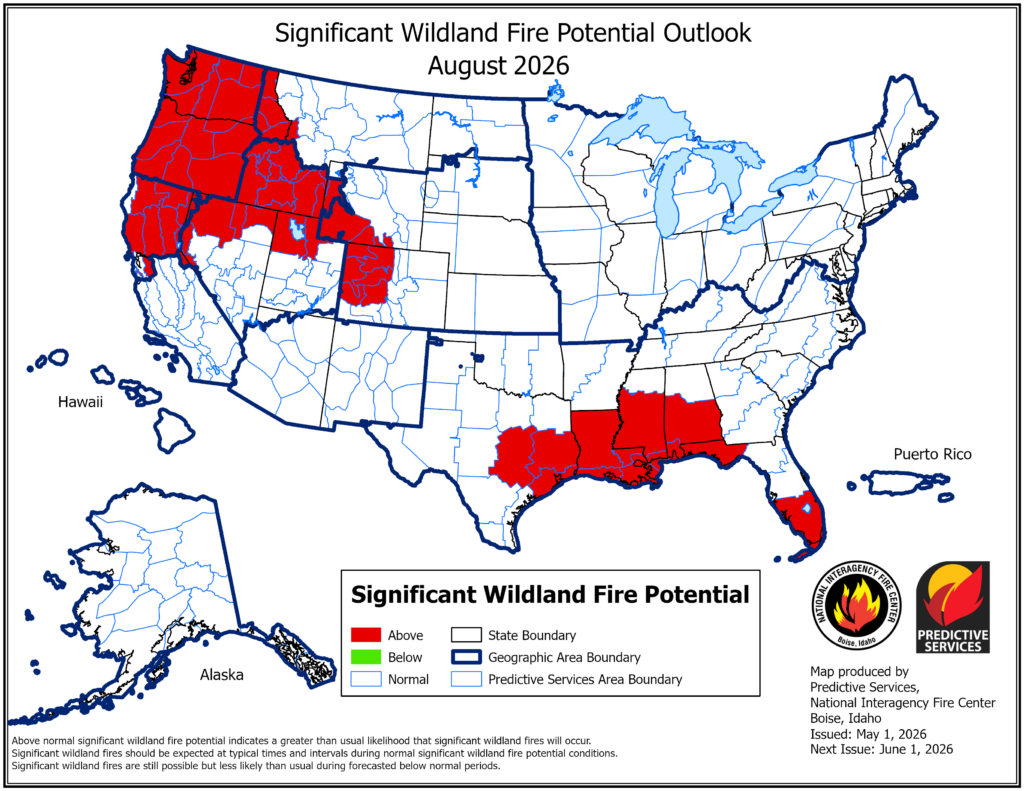
While the previous maps showed a progression from the north in June, expanding through the center and southwest in July, the August outlook shows the entire state in red, confirming that no part of the state is expected to have “normal” significant fire potential.
In 2025, Oregon experienced its third-hottest year on record, according to the National Oceanic and Atmospheric Administration, which has data dating back to 1895.
Rainfall in May and June plays a crucial role in determining whether the state will experience an early start to the fire season. As of early May, the Willamette Valley region is running below normal for the water year, with some areas at 71% to 86% of normal precipitation.
According to the National Integrated Drought Information System’s 2026 drought report, this year’s snowpack is the lowest in state history, breaking the previous record low set in 2015, putting the state in a critical deficit by April 1.
Additionally, the winter of 2025-’26 tied with 1934 as the warmest on record in Oregon.
The lack of snow is expected to cause severe water shortages, intensify the 2026 wildfire season, and negatively affect recreation and fisheries. The McKenzie River is measuring just 5% snowpack this year.
“I live near the McKenzie. It is measuring lower than it ever has since we’ve been recording the depths of these rivers. It’s the beginning of May, so that’s a problem,” said Rep. Val Hoyle at the conference.
Dave Larson, the area director for the Oregon Department of Forestry, said ODF will have full staffing for the fire season, with about 1,200 employees throughout Oregon. However, “there’s really never enough resources in the system,” he said. “As you look at that map there, with the amount of red and the amount of fires that could be in those regions, you can rapidly start running short on resources.”
Plan ahead
The ODF urges residents to exercise caution when disposing of yard debris.
During the 2025 fire season, the Oregon Department of Forestry reported that people were directly responsible for sparking 740 wildfires that burned over 20,000 acres. Any spark can gain traction in dry vegetation, spread quickly, and impact lives, personal property, and the many benefits provided by Oregon’s scenic natural areas.
In 2026, there have already been 23 escaped debris burns affecting 83 acres on ODF-protected land, compared to 37 escapes for 69 acres last year at the same time. With over 70% of wildfires in Oregon caused by human activity, escaped debris burns pose a significant risk, especially with predictions of a hotter, drier summer.
To mitigate potential wildfire impacts, Dennis Lee, the emergency response unit manager with the Oregon State Fire Marshal, suggested that folks prepare their homes now.
“Look at what’s around your house,” Lee said. “What do the gutters look like? What’s going on with the leaves? Do we have flammable material in places right next to the house? We really want folks to concentrate on that first five feet of space between house and vegetation.”
“Help your neighbors,” said Heather Buch, Lane County Commissioner. “There are a lot of people out there that don’t have the resources or don’t have the physical capability of ensuring that their property is safe when it comes to the driest season of the year.”
Residents are encouraged to consider alternatives to burning, such as chipping or composting. If burning is necessary, it’s crucial to follow safe practices: check local regulations, monitor weather conditions, keep water and fire tools nearby, clear a 10-foot buffer around burn piles, and ensure the piles are small and composed only of yard debris. Never leave a burn pile unattended and ensure it is completely extinguished before leaving the site.
As far as to-go bags go, Lee said to pack daily necessities, including prescriptions, wallets, and any documentation such as passports, medical records, and insurance policies. Other necessities include:
- One gallon of water per person per day (3-day supply) and non-perishable food.
- N95 masks to protect from smoke, a flashlight, a headlamp, and a battery-powered or hand-crank radio.
- First aid kit, hand sanitizer, wet wipes, and prescription medications.
- Tools: Multi-purpose tool (like a Leatherman), local maps, extra car keys, and a manual can opener.
- A change of clothes, sturdy shoes/boots, and extra socks.
- Oregon Wildfire Recovery and Response recommends folks pack the “Six P’s” when preparing a go-bag:
- People and Pets: Food, water, medicine, and comfort items.
- Prescriptions: Medications, glasses, and medical devices.
- Phones: Chargers, cables, and power banks.
- Plastic: Cash, credit cards, and ATM cards.
- Papers: Important documents (IDs, birth certificates, insurance policies, deeds).
- Pictures: Irreplaceable photos and memorabilia.
Buch said preparation is happening in advance of the season at the county level, by ensuring communication is available in a variety of ways, working with the sheriff’s office regarding evacuations, and scenario planning with community partners.
Resources are available on the county’s website where folks can sign up for emergency alerts, understand what the different evacuation levels mean, monitor current conditions, and learn how to have a plan for pets and livestock.
Wyden said Congress needs to increase funding for wildfire issues and criticized proposed cuts in forest research. He said weather balloons, used for collecting atmospheric data, continue to be cut despite protests, and that budget for forest research has been zeroed-out all around the state.
According to ODF’s 2025-’27 biennium adopted budget, the agency had requested $99.3 million in federal funds and only received $85.1 million, about a $100,000 decrease from the previous biennium approved budget.
“What I hope we can do, the congressional delegation, is build up the partnership that we’ve always had between the state and the federal government in terms of fighting fire,” Wyden said. “It hasn’t been a political issue, frankly, until now.”
Throughout May, a new wildfire prevention topic will be shared each week to help homeowners and outdoor enthusiasts learn how to prevent their outdoor activities from sparking the next wildfire. For more information, visit the websites for Keep Oregon Green at keeporegongreen.org, the Oregon Department of Forestry at oregon.gov/odf, and the Oregon State Fire Marshal at oregon.gov/osfm/education/pages/prevent-wildfires.aspx.