
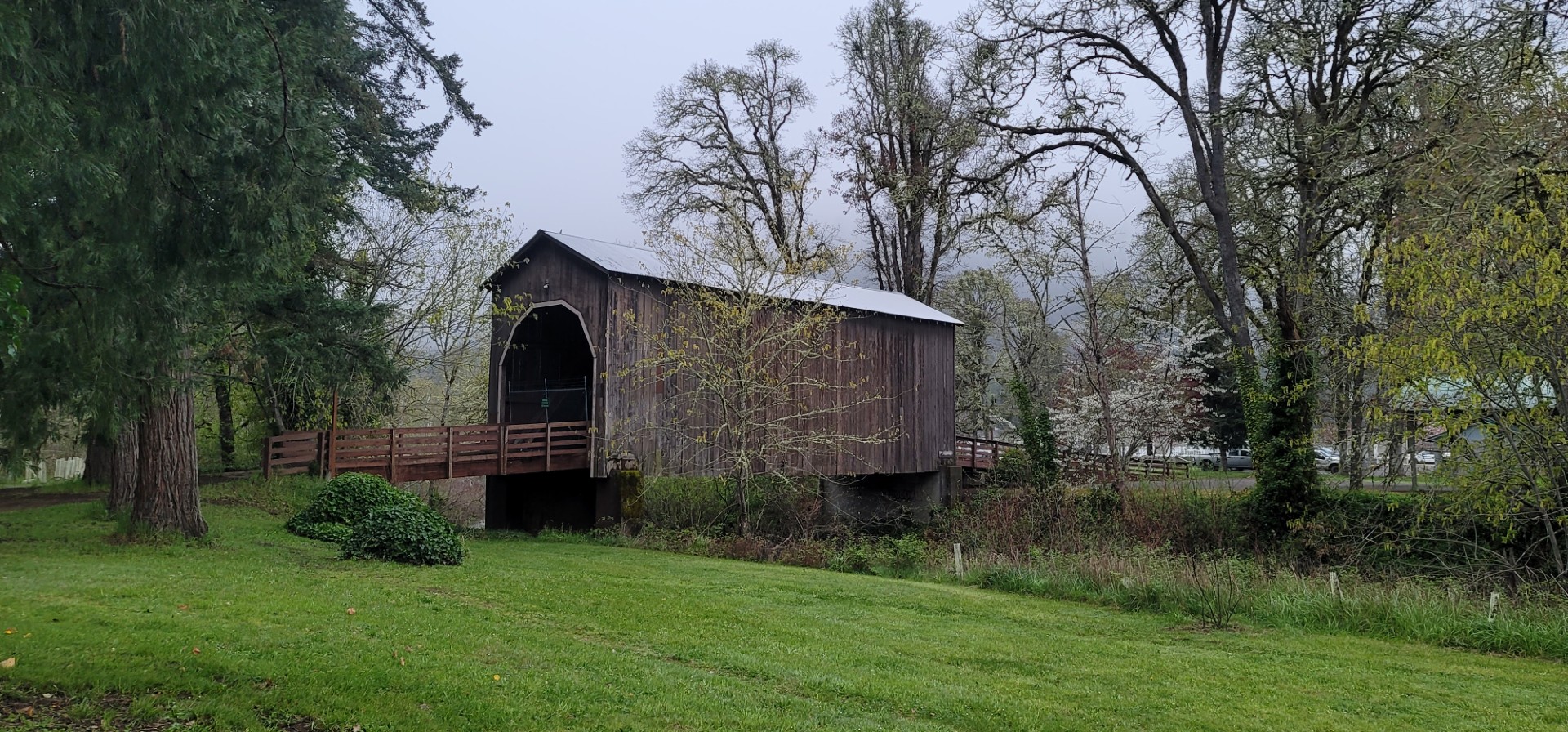
DRAIN – City officials have approved moving forward with the nomination of the Pass Creek Covered Bridge to the National Register of Historic Places, marking a major step toward formally recognizing and preserving one of the community’s most significant historic resources.
The Pass Creek Covered Bridge at 101 W. A Ave. is one of fewer than 50 remaining covered bridges in Oregon, a state that once had more than 400. Its timber Howe truss design reflects a critical period in American engineering, and the bridge’s exposed interior structure provides rare insight into historic construction techniques.
Deep community roots
The bridge site predates the formal incorporation of the City of Drain and played a central role in the community’s early development. It served the Overland Stagecoach Route established in 1876, connecting Roseburg to Scottsburg and linking the Willamette Valley to the Oregon Coast. The bridge also functioned alongside early railroad infrastructure, connecting wagon, stage, and rail systems.
Public inventories and oral histories recount residents crossing the bridge by lantern light in horse-drawn conveyances, underscoring its role as a shared experience across generations. When the bridge was closed to vehicular traffic in 1981 due to deterioration, the City chose relocation and preservation over demolition, moving the bridge in the late 1980s to a public park behind the Civic Center.
Today, the bridge remains City-owned and City-maintained, intentionally located in a prominent space near picnic areas, restrooms, and downtown amenities.
Delayed recognition
The Pass Creek Covered Bridge was not included in Oregon’s 1979 National Register nomination for covered bridges due to nomination standards and local conditions at the time. That nomination prioritized bridges that remained in their original vehicular locations and retained a high degree of structural integrity.
Preservation standards have since evolved. Today, the National Register recognizes that relocation undertaken to save a historic structure is appropriate when it preserves historic fabric and supports continued public access and interpretation.
The bridge retains exceptional historic integrity, including hand-hewn timbers believed to date to the 19th century and a largely intact truss system.