
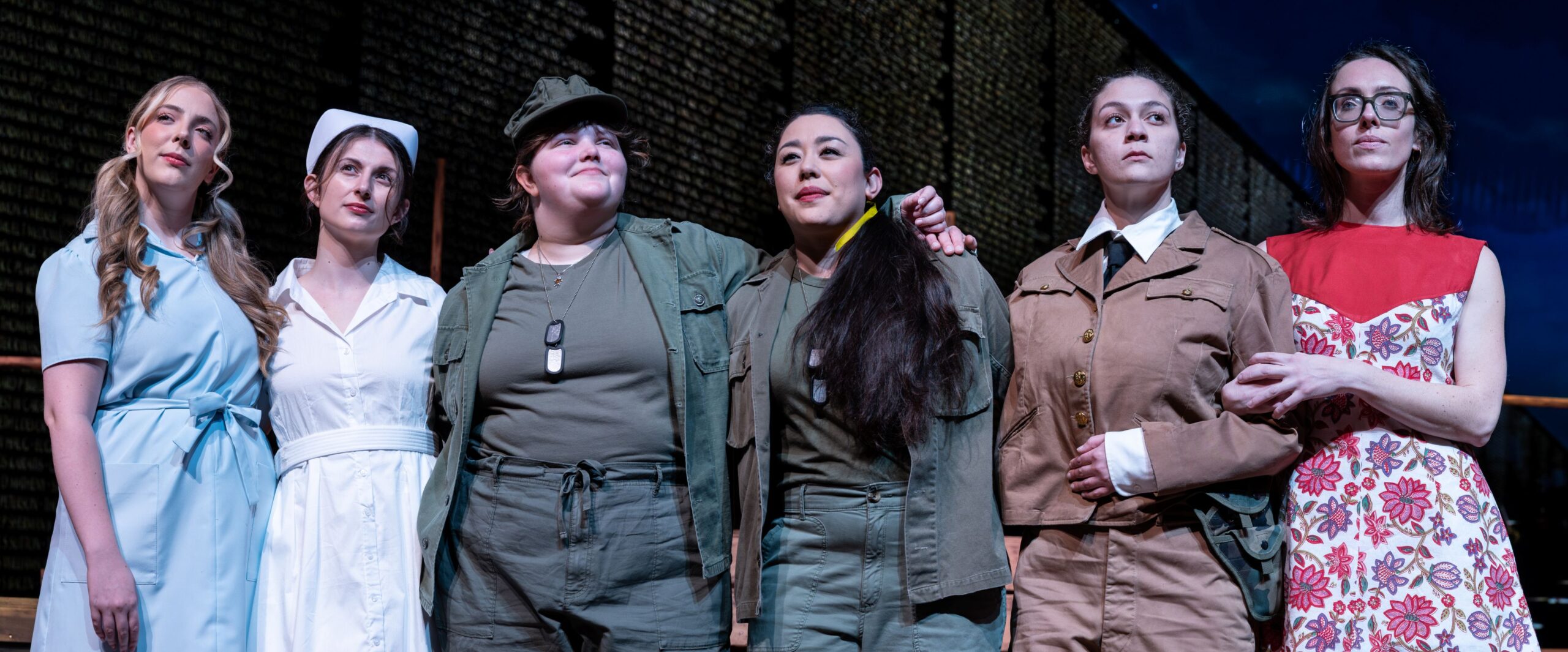
When Rachel Lewman (formerly Donaldson) was 17 and a student at Cottage Grove High School, she played the character “Steele,” an army intelligence officer, in the play “A Piece of My Heart.” At the time, Janet Rust was a high school theater teacher, directing the play.
Now, 16 years later, Rust is directing the play again, though this time at Cottage Theatre, and Lewman is reprising the role.
“Because it had been so long, I was really nervous, so having this show, director, and character all be so familiar really helped confirm that it was the right time for me to do so – especially since it was such an impactful piece as a teenager,” Lewman said.
As an adult, Lewman has more life experience to draw on, enriching the role and adding depth to her character.
One audience member, Daryll Lynne Evans of Eugene, said that Lewman “really embodies that military ethos.”
The entire ensemble gave an emotionally raw and heartfelt performance. There were many touching and poignant moments when I heard sniffles in the crowd as people cried.
Rust originally selected this play after a friend of hers directed it at her high school in Portland 17 years ago.
“It is an extremely powerful piece showcasing women in the Vietnam War. I was born in the 60s, so that is the war that was happening in my youth,” Rust said. “After directing an extremely successful production at the high school, the play just kind of stayed in my mind. I wanted to do it again with higher production values and adult women.”
The play is based on the true stories of six women in the Vietnam War: an officer, nurses, and a singer booked to entertain the troops. The timeline ranges from the time they enlist, the dangers they face during the war, and the PTSD, chauvinism, and gaslighting they wrestle with afterward, while facing a lack of support back home.
Written by Shirley Lauro, this play first debuted in 1988 in New York at the Manhattan Theatre Club.
“I’m extremely impressed with the cast I have been working with. They are allowing themselves to go to some dark places, which isn’t always easy,” Rust said.
“It was intense!” said Anne Hughey, an audience member who came to the play on opening night last Friday, which runs through Feb. 22 at 700 Village Drive.
Intense experience
Audience member Toni Horodysky of Eugene read the book over 20 years ago, which includes the stories of 26 women.
“That book stuck with me. Women don’t get credit … and this gives it to them,” Horodysky said, As a history buff who has read about WWII, Korea, and the Vietnam War, and someone who enjoys theater, Horodysky said this play was right up her alley.
Rust warns, “There are sounds of war, and obviously talk of war, but there is also talk of sexual assault, so people who may be triggered by those issues should not come to the show.” As Rust explains, the subject matter of war is dark – but important in our time – and any time. A play like “A Piece of My Heart” isn’t meant to be the fun, lighthearted romp that makes us forget about the current wars and atrocities in our world and country right now.
It only makes it more heartbreaking to know this is based on true stories of women who served in the military and as civilians, manipulated and cheated by unscrupulous agents and recruiters, shot at and attacked, and who experienced gruesome death after death.
Rust is correct that this play isn’t right for everyone. On opening night, I heard a man explain why this play should have been told from the male soldiers’ point of view and how much more horrible their situations were. If real-life examples from this play can’t convince someone why female perspectives during war are important or how the added variable of being female during a war makes one an additional target, I don’t know what will.
During this war and others, military and civilian nurses and the civilian entertainers were not given weapons to protect themselves. They found themselves in situations where the enemy wasn’t just the Viet Cong, but also prisoner of war patients who tried to attack them, the “brass” officers who gaslit them, and the American soldiers who raped them.
Now, just as then, women find themselves in war zones, facing the same threats, dismissed and gaslit because they aren’t doing the “real” fighting. As more women’s rights are eroded in other countries with patriarchal values, as well as in this one, stories that illustrate the past are important to remind us of the present.
Sarina Dorie is the arts writer for The Chronicle.