SPRINGFIELD – Due to a $2.34 million budget deficit for the 2025-26 school year, Springfield Public Schools (SPS) will implement a massive staffing reduction effective Jan. 30, eliminating 36 positions, including 27 certified full-time equivalent employee layoffs.
The news has prompted student protests during lunch breaks and petitions circulating by former students to recall the board members who voted in favor, with one petitioner, Ky Fireside, stating that “When a district chooses mid-year layoffs, the whole community is disrupted. Families lose income stability, student support systems break down, and trust collapses.”
During the Jan. 12 SPS board meeting, Springfield Schools chief operations officer Brett Yancey said the district identified that the budget deficit results from insufficient funding to sustain current licensed staffing levels.
“The adopted 2025–26 General Fund budget assumed a zero percent cost-of-living adjustment (COLA) for all employee groups across the District,” reads the board meeting packet. “To remain within the adopted budget, staffing levels for classified and administrative employees were adjusted in summer 2025 to reflect updated compensation and benefit costs for the 2025–26 school year.”
Yancey presented Resolution #25-26.032 to the board, requesting approval of budget cuts mid-school year. According to the meeting packet, reductions have been delayed as long as possible. The resolution maintains that the reductions taking place between semesters will minimize disruptions to student learning and instructional continuity.
Voicing concerns
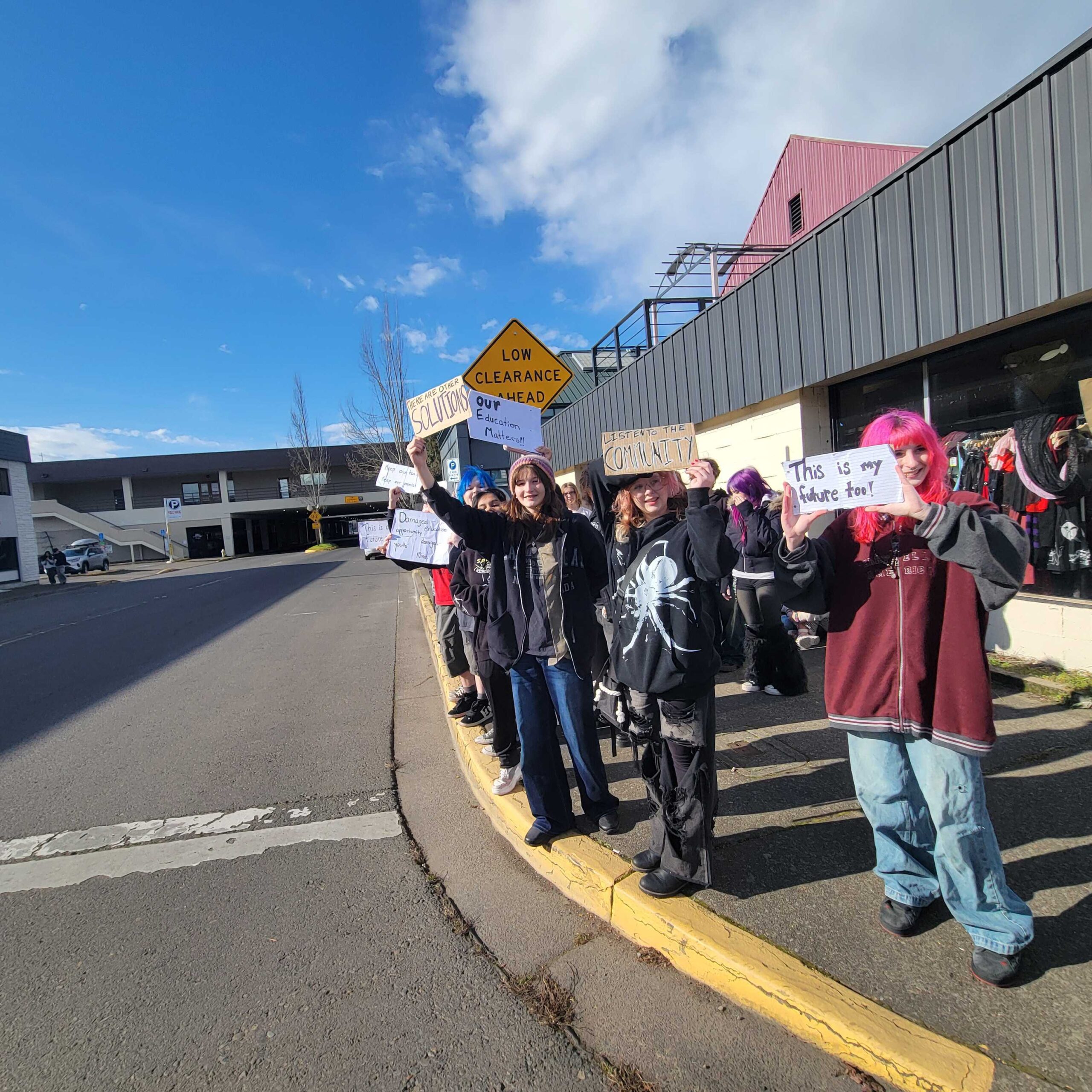
On Monday, Jan. 27, Lily Whitlock and Juno Jones, juniors at Academy of Arts and Academics High School, took to the corners of 7th and A Streets with a group of their classmates to voice their concerns. They say these staff cuts will make it harder to maintain educational quality at their already understaffed school.
“They fired our language arts teacher, and she was the one who taught us our civics in our language arts class, and without her, we’re not gonna have a proper education,” Whitlock said.
“The district is already understaffed; they just took away more teachers when we need more help.”
Fireside, a Springfield High alum, said on Tuesday that the decision to lay off the teachers “shattered that stability for students and educators,” noting that middle schools took the hardest hit, with 16 full-time reductions.
While some folks are taking to the streets, others are voicing concerns in the boardroom.
With over 254 attendees and over half an hour of public comments from teachers, parents, and SPS staff members, concerns were raised about the abrupt staffing reduction at January’s meeting.

Cliff Schutte, a sixth-grade teacher at Agnes Stewart Middle School in his 27th year, emailed in his public testimony, saying he was disappointed with the lack of public input. Schutte said he also provided public comment during the board meeting in May 2025 when the budget was discussed.
“You did nothing but rubber-stamp the budget that was presented to you… And here we are, with a mess. We have to do better,” Schutte wrote. “The idea that reducing district-wide building staffing mid-year is the only and best solution to your budgetary debacle is asinine.”
Other teachers also emailed their public comments and asked the board to consider other options to make up the funding shortfall. Sarah Ferren, a Springfield teacher with 16 years of experience, asked for more staff input.
“I realize these decisions need to be made quickly, but it wouldn’t take long to put out a Google form asking for input, perhaps asking us to order areas of importance,” Ferren wrote in an email. “One of the main complaints that our union has had with district leadership is the tendency to make top-down decisions, without asking for input about how it would affect classrooms.”
Between a rock and a hard place
Yancey said in the meeting that this discussion began in March 2025, during an executive session, when the board established bargaining parameters. They anticipated that those parameters would necessitate staff reductions.
According to Yancey, the board considered multiple scenarios and reached consensus on the parameters provided to the district’s bargaining team. He said those parameters were reaffirmed in another executive session in April. In May 2025, the board proposed the 2025-26 budget to the budget committee with a 0% COLA. The budget passed unanimously in June.
“People tend not to pay attention until we get to this point,” he said.
Ultimately, the board approved the resolution by a 3-2 vote. Jonathan Light and Amber Langworthy voted against it, while other board members expressed concerns about the cuts while voting in favor.
“It feels like we’re between a rock and a hard place,” board member Ken Kohl said. “We’re trying to balance what we do for the kids this year, versus future classes of kids and how they’re impacted. I’m not sure there’s a win here.”
Petitioning against those in favor
Former students Fireside, Abraham Constitino, and Devon Lawson have banded together to file the recall petitions for Heather Quaas-Annsa, Ken Kohl, and Nicole De Graff, the board members who voted in favor of the budget cuts.
“This recall isn’t personal; we respect their service. This is about enforcing standards,” said Lawson, a 2025 McKenzie High School graduate and student at Lane Community College. Lawson, with a clear interest in politics, also ran for a seat on the LCC Board of Education last May.
Fireside, who was formerly a unionizing Starbucks barista, said that “the district tied these cuts to bargaining efforts with the union. As a strong union supporter and a union organizer myself, I reject the excuse that these cuts were necessary while negotiations were still ongoing.”
Fireside, a recent Springfield High graduate who is running for a seat in the Oregon House’s 7th Legislative District, also cofounded the Eyes off Eugene advocacy group that campaigned against the now-deactivated Flock cameras in Springfield and Eugene.
They said the board did not exhaust all its options before making this decision.
“They could have asked about the viability of some of the community-proposed solutions. Anything should have been cut before the staff that directly support our students. The board could have called for an emergency session and a new vote after realizing their initial mistake,” Fireside said. “This should have been the board’s last option, not the first.”
Each petition needs 4,826 signatures by April 16 to have legs and make its way onto the ballot for voters to ultimately decide. Lawson said there are 29 volunteers ready to “gather signatures at board meetings, community events, and spots like Thurston Station.”
Board members react
Board member De Graff said she is aware of the recall petitions and understands how painful the situation is for the community, saying that the vote at January’s meeting was “one of the hardest I have had to make,” she said.
She said in her experience, budget alternatives had been carefully considered. Individual staffing decisions about the reduction in force (RIF) are not made by the board, but by administration, according to contracts and state laws.
“I share the same sadness and loss along with the community as a parent with children in the district because I have always advocated for kids first and foremost,” De Graff said. “My heart goes out to all the staff affected. My focus remains on supporting students and the long term stability of the district during a very difficult budget year.”
Board chair Quaas-Annsa also responded for comment in regards to the petitions.
“I respect the right of community members to express their frustration and disagreement. At the same time, I believe it’s important to separate the very real anger and pain people are feeling from the facts of how this decision was made and what authority the Board does and does not have,” Quaas-Annsa said.
She shared a similar testament as De Graff, saying that board members spent considerable time discussing and researching other options.
“Furlough days can’t be imposed by the Board and require agreement from all bargaining units. A levy isn’t a sure thing and takes significant time and community outreach to do responsibly. Selling district property is slow and uncertain. And reserves are one-time funds; you can’t sustainably pay ongoing costs with them any more than you can pay rent forever with a savings account,” she said. “All of this is happening after decades of serious disinvestment in public education, which has left districts with fewer real options year after year. People can disagree about which option should have been chosen, but the suggestion that the Board rushed this decision or ignored other possibilities is inaccurate.”
Quaas-Annsa also said other bargaining units across the district were involved in the discussion and reached agreements months ago that included COLAs and reductions in workforce or absorbed staffing reductions to offset labor costs.
“To students, SPS staff, families, and the broader community: I know this decision has caused frustration, disruption, and a deep sense of loss,” Quaas-Annsa said. “I remain committed to transparency about the Board’s role and learning from how this process has been experienced by those most affected. I continue to highly encourage and welcome community input and engagement, even when it’s painful or deeply uncomfortable.”