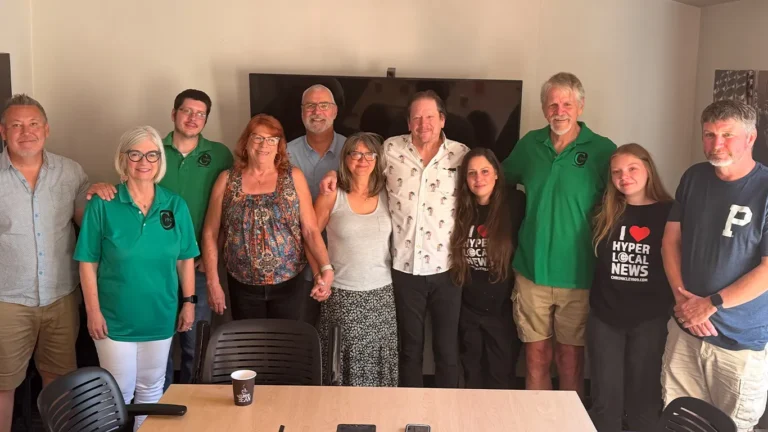
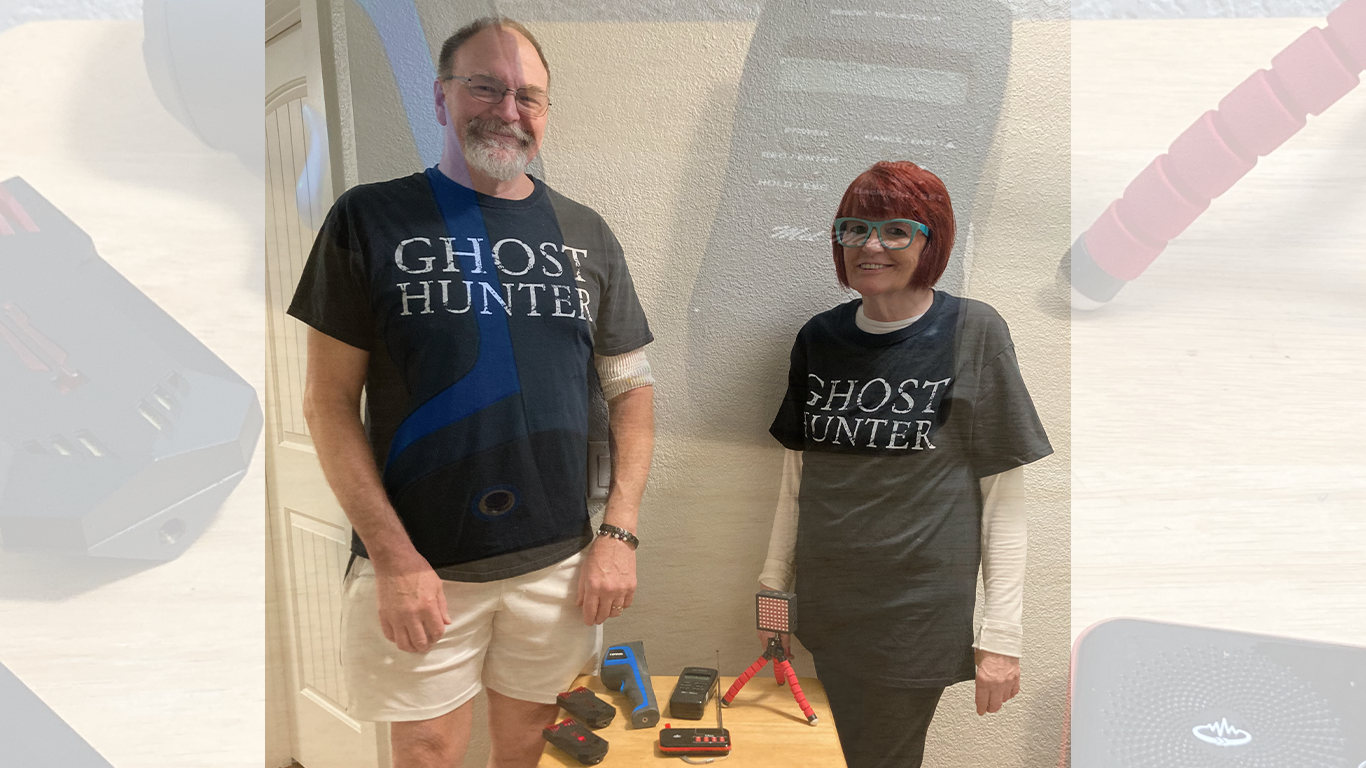
“The West Coast has lots of ghosts,” says Judy Goldbrand of Ghost Investigators.
Before living in Oregon, Goldbrand resided in Minnesota, where she said she didn’t encounter as many ghosts.
She has been hunting ghosts with her family for over 12 years, and they now have five members on their team. Before that, she had few ghost experiences – and then invested in equipment to track them.
She convinced her brother, Tom Sombs, to join her search after he had already been experiencing a spirit while working at the Gateway Post Office. In the back, he said he saw a man wearing all black with a hat who looked like he was from the 1920s. He must have seen the man at least 25 times. One of his coworkers mentioned he saw someone and described the same man to Sombs. It was only natural that a few years later, when Sombs had more time, he joined his sister’s ghost-hunting team.
How to get started
Goldbrand recommends always having sage to burn before getting started to discourage negative energies.
The equipment Sombs and Goldbrand use varies in price, but they are all accessible to people via the internet and sometimes hardware stores. The EMF, a piece of technology that detects electromagnetic fields, can be found for $20 on the low end or $35 to $40 on the high end.

When Goldbrand held the EMF a couple of feet from the television or a lamp that was turned on, a red light lit up because it was detecting electricity. Approaching a person, it did the same.
Theoretically, the EMF light should not turn on in a space without electricity.
However, as we approached a cold spot in Sombs’ Springfield home where the demonstration was taking place, the light did turn on. Every time we approached the same place, it turned on again.
They know they have a ghost in the house.
Other devices Sombs demonstrated was a temperature gauge to find unexplained cold spots; night vision to find cold or warm spots; a ghost box or spirit box, which uses an FM/AM frequency that is in-between stations to catch words and phrases a ghost might communicate when the living ask it questions; an infrared light to catch shadows; and a free phone app that was invented in 2009 called Ghost Radar.
The last time they used the infrared light, they were at Our Redeemer Lutheran Church in Eugene, setting up in a stairwell to cast a light on the wall. Goldbrand had a shocking experience. “Tom walks by, I walk by, and then a third one walks by – and no one else was there!” It confirmed what church members had said in the past about a spirit being in the stairwell.
They used the Ghost Radar to find a lost object at the same church on a different occasion.
“We asked, ‘Do you know where it is?’
“It said yes. We asked it where we should go. It said, ‘Upstairs.’”
After going upstairs, Sombs asked, “‘Where upstairs?’
“The app said, ‘Choir.’”
They asked for the app to confirm it was in the choir room, and it said yes.
“So we went in there, and we asked where, and it said, ‘Desk.’ We looked underneath.” That was where they found their missing object with the assistance of the church ghost.
Reviews online for Ghost Radar are mixed. Notably, some negative reviews aren’t due to inaccuracies; they’re because of how creepy it is.
Goldbrand and Sombs both recommended having extra batteries on hand and charging devices right before ghost hunting because spirits drain electronics. “They pull energy out of the batteries,” Sombs explains.
Most of what they do is documentation and experimentation. They do not charge for their services. Coming up soon, they hope to get permission to investigate a local grocery store where a family member has experienced products sliding across shelves and dropping to the floor in front of his eyes.
Sombs likes to have a spirit medium come along with them on their investigations when possible. One medium they worked with in the past was Jeaux Bartlett, who used to teach spirit medium classes in the Eugene area. A Light Intuition classes and books are still available at ALightIntuition.com for those interested in developing their skills or learning how to turn off their skills, though Bartlett is focused on other writing projects at the moment.
Sending spirits to the light
It is one thing to seek out ghosts. It is another situation when they haunt a house. For those struggling to get rid of ghosts, a spirit medium can assist.
Bartlett used to be a spirit medium, sometimes giving clients information that they could then check with family and corroborate. One task Bartlett assisted with was helping the living who were haunted by ghosts.
Bartlett’s process for clearing out spirits involved starting with grounding and quiet meditation, tuning into the energy around them, focusing on the sixth sense, and then connecting with that person or spirit.
“Ask questions like a reporter,” Bartlett says with a laugh. “‘Who are you? What are you doing here? You seem stuck. What’s going on?’ I ask with curiosity, not judgment. It sounds ridiculous, but I do ghost therapy. … People who are stuck beings have some misbelief of the afterlife and what will happen next. They are confused and afraid online. They don’t know they have loved ones waiting for them, which is what I believe … Send that darkness-and-stuck feeling (and instead) send them toward the feeling of light. That helps lighten the energy.”

“The love energy that we experience as humans, that can continue on.“
– Jeaux Bartlett
The concept of going toward the light is based on Christian theology – which might not work for everyone.
“It is very touched by an Angel – go to the light,” Bartlett says. “It isn’t necessarily heaven or hell, it is about levels of vibration. Our soul lives on in some form after this life. Love continues on after death. The love energy that we experience as humans, that can continue on. It doesn’t have to be as complicated as we make it.”
It is a wonderful message for the dead as well as the living.
Sarina Dorie is the Arts writer for The Chronicle.