
SPRINGFIELD – Have you ever wondered how electricity travels from the massive power lines stretching across the hills to the wall sockets and appliances in your home, like your microwave?
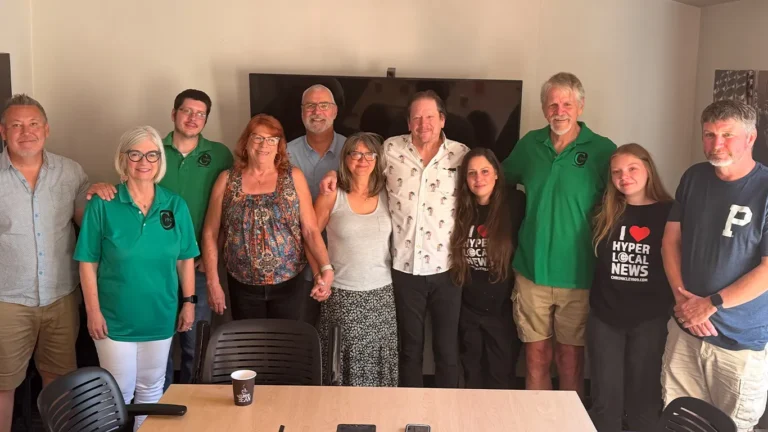
Last week’s tour of the new Glenwood Substation, currently under construction on the south side of Glenwood, offered a glimpse into how electricity travels from massive power lines to the appliances in our homes.
Organized by the Springfield Chamber of Commerce in partnership with the Springfield Utility Board (SUB), the visit highlighted the state-of-the-art facility that will enhance local power distribution.
During the walkthrough last week, Sanjeev King, director of the Electrical Division, explained the process of electricity distribution at the substation.
High-voltage power enters the facility, is divided, and passes through switches before being sent to a transformer – one that has already incurred significant investment, costing more than $1 million and taking a year and a half to deliver.

Once electricity exits the transformer at a lower voltage, it is further divided for distribution to local neighborhood lines. These lines are equipped with smaller transformers, ensuring that households receive the standard 120-volt power at their wall sockets.
The Glenwood substation is designed to relieve other substations in the region, contributing to a more resilient electrical grid and minimizing the risk of outages.
Jeff Nelson, SUB’s general manager, noted that planning for future growth and potential large electrical users, such as McKenzie-Willamette Hospital, prompted a thorough examination of Glenwood’s power supply, which led to the development of the substation.
The time from identifying a need to completing the infrastructure can be quite lengthy. The project has taken approximately seven years from initial construction planning to its current stage, mainly due to the time-consuming agency approval process.
Safety measures, such as the moat around the transformer, designed to catch any transformer oil leaks, are responses to permitting requirements. Many agencies required numerous answers before construction could begin. And in a departure from many smaller utilities, SUB is managing the construction with its own workforce.
Future expansions are also being considered, as the substation’s design accommodates the addition of a second transformer.
Greg Miller, director of SUB’s water division, provided insights into ongoing improvements to the water system, including a planned 30% increase in surface water membrane treatment capacity at the Thurston Well Field.
This new facility will serve as a second surface water treatment plant, sourcing water from the McKenzie River, while the existing facility draws from the Middle Fork Willamette River.

Miller said that permitting for water facilities can be both time-consuming and costly, especially when involving additional agencies when a river is part of the project.
Miller also discussed upgrades and changes to transmission lines to better balance and enhance the overall system’s resiliency, which is necessary to keep as much of the system operational as possible during shutdowns for upgrades to piping or wells, line repairs, and in the event of accidents or potential contamination releases.
The new surface water treatment facility aligns with SUB’s resiliency goals. If a spill contaminates the river, the issue will dissipate relatively quickly, as all the water in a river is replaced within a year.
Additionally, wells provide robust backup options. If a well becomes contaminated, other nearby wells and surface water facilities can step in as alternatives. The intertie with EWEB, which is also slated for potential upgrades, provides an additional layer of protection, ensuring that both utilities can support each other.
The following steps for the Glenwood Substation project include completing the construction, which is expected to be finished by spring 2026.
As the facility is nearing operational status, Nelson warns that access will be limited due to safety concerns related to stray currents, as stray visitors and stray currents simply do not mix well.