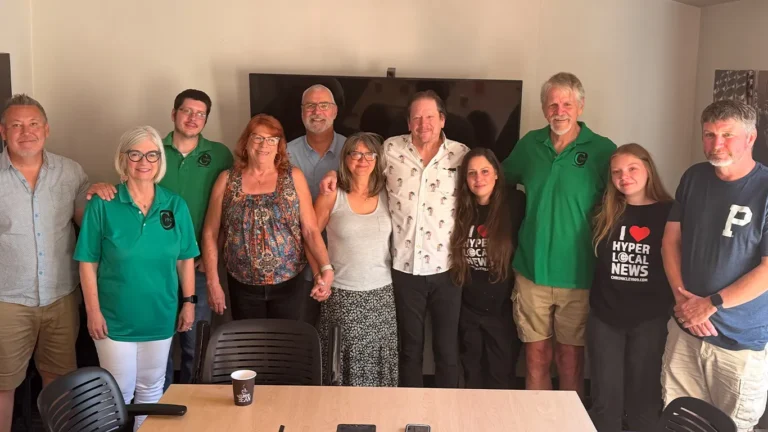

SPRINGFIELD – Roughly 100 people gathered in the city council chamber at town hall last week to talk with the mayor about proposed budget cuts to Springfield’s library.
On Tuesday, Sept. 9, Mayor Sean VanGordon had an open discussion with concerned members of the public. He began by providing background information on a fiscal stability report, highlighting the complications the city faces due to its General Fund operating deficit.
Earlier this year, a Fiscal Stability Task Force, a volunteer committee of 12 members, met to discuss options to address Springfield’s projected budget shortfall of an estimated $4.5 million by fiscal year 2027–28. On July 22, the Springfield Chamber held a roundtable event with the mayor to inform the public of the options that the Task Force, along with two paid consultants, had come up with.
Consultant Anne Marie Levis of Funk/Levis & Associates facilitated meetings, and ECOnorthwest led the report drafting and provided fiscal and policy analysis.
VanGordon said the report focuses on four different issues: revenue, potential cuts, economic development strategies, and legislative strategies. Among the possible cuts is a $500,000 reduction to the library budget.
“That step in the committee was really about getting technical advice on how to fix four and a half million dollars. The step we are at (now) is weighing community input on what is the best mix of things for Springfield,” the mayor said.
At the town hall on Tuesday night, paper cards were provided for folks to leave questions and comments on. VanGordon addressed about a quarter of the written questions while also answering questions from the crowd as they transpired.

With a start time of 5:30 p.m., the event was scheduled to end an hour later, but by 6:30 p.m., the room was still full of passionate people voicing their concerns about the library.
“I wanted to have a conversation. The reason why we put the comments on a card is so that all this stuff can be taken to the city councilors, and so that everybody sees the same information,” VanGordon said. “What you tell me here and what you write down on your comment cards really does help. I’ve done this for a long time. Anytime the public weighs in, it is super helpful.”
Comments from the crowd
The room was full of library board and staff members, Springfield Chamber and council members, and supporters of the library.
The first question VanGordon read regarding the library drew an immediate round of applause from the crowd. The card read, “Are you aware of the outstanding performance of the library over the past four months?”
The next card the mayor read suggested raising the price of library cards and reducing periodicals as a way to keep the library open on Saturdays.
“We don’t know what the cut means,” VanGordon said. “We know it could mean closing for a day. We know it could be changing programs. I’m waiting for the city to get into some of these conversations and for the city manager to really tell us what our options are for if we did this, and what it would potentially look like.”

He urged the crowd to let him and the council know what parts of the library matter most, whether it be programs or hours, “Please tell us that. There will come a point when we ask our city manager what are our actual options… and knowing where you want to go as a community would help that conversation tremendously,” he said.
The next question wondered why the city is considering slashing the library budget by nearly 25%, and leaving other service budgets untouched.
To that, the mayor responded by explaining that the city has been progressively cutting revenues to balance the budget.
“What I’m asking you not to do is sort of see that moment in one single budget, but instead, back up and see the trend of us consistently cutting city services over probably a 30-year period,” VanGordon said. “We face a structural problem. That’s ultimately what we’re trying to get through.”
He admitted the 25% cut feels like a lot, but he also said both police and fire are also facing significant cuts. According to the report, one of the recommendations is to increase current levies to cover the costs outlined in the ballot for Police and Fire & Life Safety levies in order to generate $1,300,000.
A question was raised about the timeline for a final decision and whether implementing a library levy was an option. VanGordon said the challenge with an operating levy is that the framework for one hasn’t been done yet.
“We’re working on the front half of this potential project. So, I couldn’t tell you today that we’ve done any other community work that requires good support for an operations Levy, or any of that sort of polling work, or the staff work to put something on the ballot,” he said.
He also said the team is working toward a December timeline, but wanted to make it clear, “It’s not that all the implementation work is going to be done, but to say very distinctly what our strategy is.”
A long-time teacher questioned the legality of starting a GoFundMe to raise the $500,000 for the library. She said she calculated the numbers and figured that if 5,000 people pitched in $100, the funds could be covered. The mayor referred her to the Friends of the Springfield Library organization, which the teacher already knew about, and pointed out that their funds wouldn’t support the proposed cuts.
Another crowd member pointed out that the Springfield Library is one of the lowest-funded libraries in the state for a community of its size, whereas Eugene is one of the highest.
Page 59 from the city’s FY26 Adopted Budget indicates the library accounts for roughly 2% of the total operating budget funds, police make up 19%, and Fire and Life Safety are another 17%.
Somebody questioned how the panel for The Task Force was chosen, and wondered how involved and familiar the members were with the library, and in Springfield. The mayor said that he had chosen the members on the panel.
“I was looking for a group that had technical skills and technical advice for the city council,” he said. “I looked for folks that had expertise in finance, had large-scale, large employers, and had a broad swath of what was represented in this community.”
A community member followed up with VanGordon on this subject.
“A question about that is, the report describes them as 12 community members representing a diversity of the city. What you just described was a skills expertise, not community membership,” they said. “Repeatedly today, you’ve put it very much like the experts versus us, the public, implying that we lack some kind of knowledge. That also sounds like what the committee maybe lacked was representation of the community. … I would like to know how many of the 12 live in the community.”
Levis chimed in, noting that seven out of the 12 members live in Springfield and all work there.
Two weeks ago …
At the Sept. 2 Springfield city council meeting, public testimony was already bringing concerns of the library’s budget cuts to the council’s attention. In fact, the first two public comments from that night’s meeting addressed the proposed cuts.
James Lauinger urged council members to attend the library’s free screening of Free for All: The Public Library, which shows the critical role libraries play in shaping America, and how they continue to be a sanctuary for Americans everywhere.
“Historically, libraries have played a critical role in providing and building a strong democratic society,” Lauinger said.

Elliott Harwell said she spent some time over the summer researching the library’s proposed $500,000 cut of its $2.2 million budget. She also pointed out that “the council has presented the Mayor’s Fiscal Task Force as being representative of all Springfieldians, but nine of the 12 members represented corporations,” she said.
“At the work session before this meeting, the City Council heard that if they increase the proposed payroll tax by 0.02% they would be able to cover the shortfall for the library,” Harwell said.
Currently, the report of the Mayor’s Fiscal Stability Task Force proposes implementing a shared employee and employer payroll tax to generate $2.3 million.
During the work session before the public comments, City of Springfield finance director Nathan Bell said that under guidelines from The Task Force and with the help of consultant ECOnorthwest, the number they arrived at for the proposed payroll tax was 0.1%.
“What they liked about it is that it is easy to understand in terms of its impact, easy to multiply out, and it got us close to the original target that we wanted,” Bell said during the work session.
“The proposed payroll tax is supposed to be equally split between businesses and employees, and currently, the conversation is completely about representing businesses and interests, not the employees who will also be paying into this tax at the end of the day,” Harwell said. “If we can’t pay for a library … We don’t have a city. We have a business market,” he said.
Monday evening …
During the Sept. 15 city council meeting, Bella Yeager, secretary of the board of Friends of the Springfield Public Library, suggested alternative budget recommendations that will protect the library while addressing the fiscal challenge head-on. She prepared a report for the council and pleaded her case.
“We should expand and prioritize the strategic sale and development of city-owned properties,” she said. “We need to reform police overtime. Last year, police overtime cost Springfield $1.7 million, nearly four times the budgeted amount. Through scheduling reforms and technology, we can achieve a 40-50% reduction in excess overtime and save nearly $500,000 a year– enough to cover the library share without cutting services,” Yeager said.
She also suggested the city delay nonurgent equipment upgrades, adjust staffing in the city manager’s office, and introduce a tax on short-term rentals.
Many community members are opposed to budget cuts to the library without exploring alternative options. They continue to show up and speak out about the importance of the local organization that provides free access to information, programs, and resources for the community.
The council is still wanting to hear feedback and suggestions from the community. They have an input survey available for residents to fill out, which can be accessed at
tinyurl.com/3knef4pb.