SPRINGFIELD – Public radio stations KLCC and KRVM are facing financial challenges after Congress’ party-line vote July 18 to rescind funding for public broadcasting. Both stations’ general managers were confident their stations would survive the cuts – citing dedicated staffers and committed listeners.
KLCC general manager Jim Rondeau wrote a letter to members last week acknowledging the station has lost more than $300,000 in direct support, creating a multiyear deficit. The station will need to increase local membership funding by 25% to make up the gap, he said.
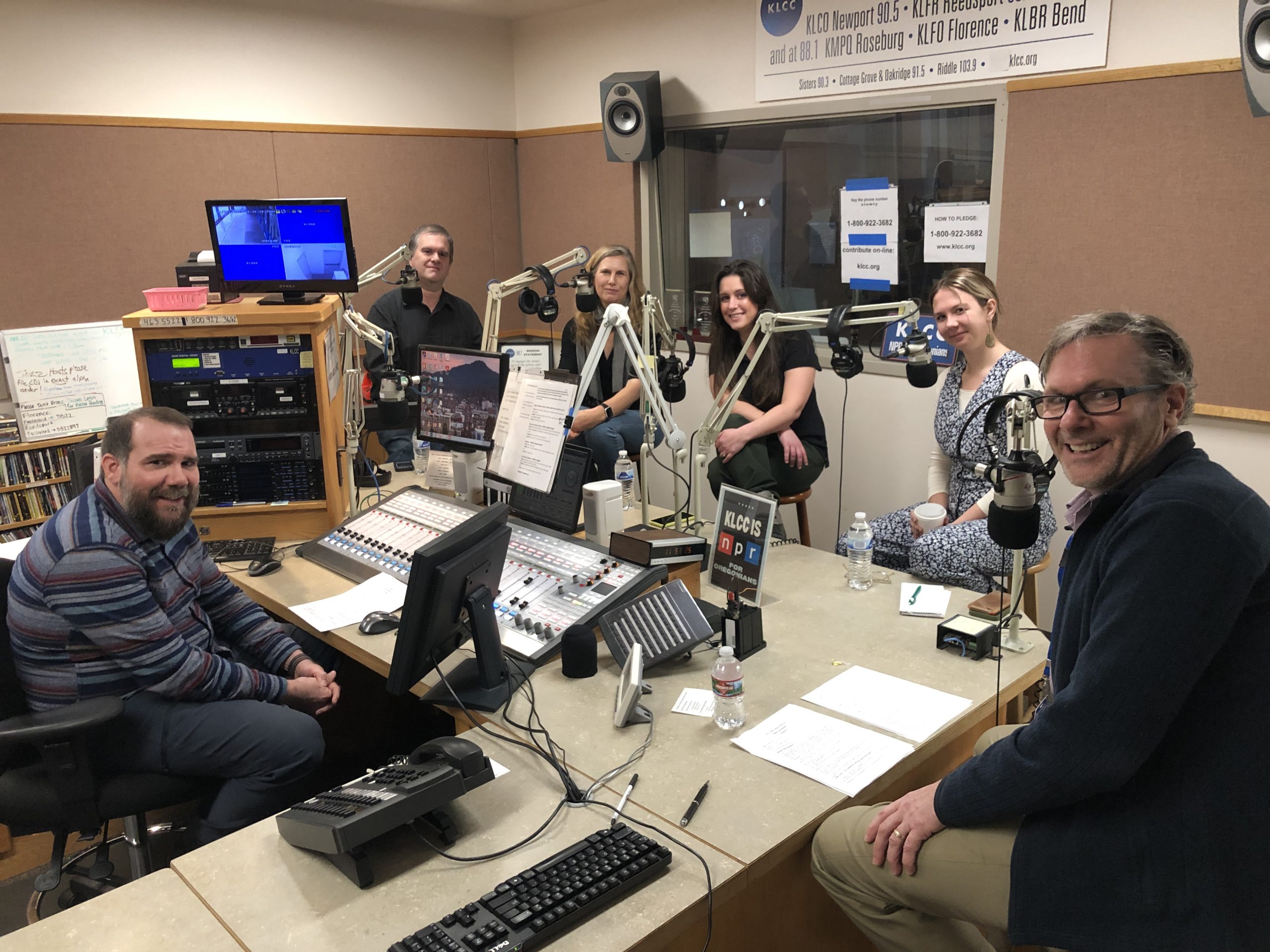
Local public radio and TV stations have had a nearly six-decade relationship with the Corporation for Public Broadcasting (CPB). Based out of its studios at 136 W. 8th Ave., Eugene, KLCC provides news coverage for a wide audience in Lane County and also carries popular national programs such as All Things Considered and Morning Edition. Some of that programming might have to end, Rondeau said.
Along with the loss of valued content is the loss of emergency notifications and alerts. Rural populations in particular rely on local radio for weather events, evacuations, and wildfire alerts, KRVM general manager Stu Grenfell said.
The CPB’s closure “is a sad day,” Grenfell said. “What CPB has done for us – making sure all citizens in the country can get emergency notifications … 13 million just lost all contact with the outside world for that information.
“The direct result of this … is that 13 million people in areas that don’t have reliable internet, don’t have cell service. The only place they get that information is on radio stations, and the only radio stations serving most of those people are public stations, because they’re such sparsely populated areas and the commercial stations can’t make any money,” Grenfell said.
Local focus
Rondeau said KLCC is prioritizing local news and content, and is evaluating its national programming contracts. The station’s local coverage, he said, is irreplaceable.
“We have made a commitment to invest locally in local news and enhanced local content,” he said. “And so our first move is to look at the programming that we bring on a national basis and decide whether or not there’s duplication,” Rondeau said.
“Frankly, we’re going to continue to be able to invest some of those funds, or at least spend some of those funds in the next couple of years, maybe not in ways we intended, in terms of expansion, but in terms of just being able to maintain services.
“The thing that cannot ever be replaced is what we do here locally, and so we’re going to lean into local wherever we can when we have a choice where $1 goes, it’s going to be spent locally, to maintain staff, to hopefully continue to add staff,” he said.
Both Rondeau and Grenfell said community response has been “tremendous.”
Grenfell said his station’s fundraiser – held on the day after the cuts were announced – brought in an additional $35,000 and that new donors are citing the federal cuts as motivation.
The support isn’t only in one-time donations. Rondeau said many listeners have switched to stable, monthly donations. He said that provides a more reliable funding stream.
“We are getting a lot of people specifically saying they are donating because the government funding has been taken away. ‘We are stepping up. We’ve been listening for years. We realize it’s our time.’ We’re getting a lot of that,” Grenfell said.
“For sure, we need to have a lot more of them. But the initial response from our listeners has been very, very nice, very gratifying,” he said.
Rondeau noted that KLCC has been financially independent from Lane Community College, which holds the station’s license, since 2018. This independence, while a point of pride, means the station is more vulnerable to federal funding cuts, he said.
KRVM’s Grenfell said his station has been responsible for its costs since 2003 when the 4-J School District sold its stations. KRVM still operates out of a studio at Sheldon High School in Eugene.
Grenfell confirmed the cuts will result in a loss of $186,784 annually – about 20% of the station’s revenue. Like Rondeau, Grenfell is turning to the community, estimating that if KRVM’s listener-to-member ratio increases from 10% to 15%, the station could become fully self-sufficient.
Emergency notifications
Beyond the immediate financial impact, Grenfell noted the loss of critical emergency notifications.
He said that a primary function of the federal funding was to ensure that citizens in rural areas, who often lack reliable internet or cell service, could receive emergency notifications.
The station’s translator stations are in need of repair, particularly those serving areas such as Oakridge, Reedsport, and Florence. Grenfell said federal funding was a major source of money to keep these stations on the air, making them a crucial source of information during wildfires and other natural disasters.
Tony Stevens, who DJs the Friday edition of “Breakfast With The Blues” on KRVM and has been a Creswell resident for nearly 40 years, said KRVM has interior equipment needs, too.
While noting he spins only vinyl on his show, CD players are aging.
“They’re limping along,” he said. “We aren’t going to have the money to replace them. The technology to replace them isn’t really there. So what happens when those CD players fail? As I see it, the overall impact for us is going to be equipment failure.”
Credible news threatened
Both station leaders expressed concern that the cuts are part of a broader trend affecting local journalism and nonprofit organizations. Rondeau said he hopes this “educational moment” will encourage more people to understand the value of local information and support the media that provides it.
“I just hope that folks will start to understand the value of information, and particularly local information, and pay for it somewhere,” said Rondeau, a 40-year radio veteran who has been GM at KLCC since 2019.
“One of the things that we think we can do is continue to function as a connector. I think the general public finds out about organizations that are suffering through the media, either through radio or print, and so we feel part of our obligation is to maintain our journalistic footprint … so people will know about the need at the food bank, or the need for an arts organization to continue funding,” he said.
KLCC is consistently rated among the top 1-2 stations for audiences in our area, according to the Nielson Media Research. KRVM is not part of Neilson’s numbers, but Grenfell says anecdotal evidence demonstrates the all-music station’s popularity.
“We have established a pretty good three- to five-year playbook, and we have a very supportive community, and a pretty good track record of funding, and all of those things are going to help us move forward,” Rondeau said. “There are no guarantees to anybody, but if you want to work in media, if you want to work in journalism, it’s a pretty good place to be. Our whole team is motivated here. And I wish that I could provide that sort of same spirit to every other organization in our industry that is facing a real, uncertain future.”
Team effort
“One of the things I really do love about our team is that we don’t have anybody here now who will say, ‘I don’t know how to do that.’ Everyone is more oriented toward, ‘Oh, okay, I guess I better learn that.‘ And I love that,” Rondeau said.
Grenfell said he’ll continue to rely on the students and volunteers.
“Our goal at this point is to keep everything on the air that we have on the air, including all of those signals,” Grenfell said. “Our priority is going to be keeping the main signal on the air, the 91.9 FM signal, and keeping our student broadcast program going. Our regular programming is all volunteer. So that’s fortunate for us. We’ve got about 40 volunteers hosting shows, and about 24 on-air volunteers.
“We’ve got a very tight-knit crew here. We’ve got a staff of four full-time people. We all work together really closely, and we all look at this as something that we’re going to get through and we’re going to find a way to do it with the minimum damage. That’s what the goal is. Nobody’s afraid to work hard. Nobody’s afraid to do what we need to do to keep it going as best we can.
“But I think we just keep our eye on the big picture, which is, a lot of people rely on us for not only emergency information, but for their sanity in some ways. That’s where something like going back to Covid, for instance, we were the only thing normal in a lot of people’s lives,” he said.
Access to alerts never easy
Sgt. Tim Wallace, public information officer with the Lane County Sheriff’s Office, acknowledged that “generally public radio is operating even when other things are down.”
“It’s certainly important in our rural areas for that emergency messaging, and also, you know, people in their cars, if you’re outside of cell reception, being able to find a radio station is usually a lot easier than trying to find the cell signal,” Wallace said.
Jessica Landstra, a captain for Row River Rural Fire Protection District and owner of Farmlands grocery in Creswell, said aging infrastructure is a real threat for local radio.
“I think that is a challenge in itself; is the station going to stay up when stuff is happening,” Landstra said. “Because that was a huge issue we saw during ice storms. During severe power outages and things like that the radios weren’t working either.
“It’s all so satellite-driven now with phones, that that’s really your best way of getting alerts. You know, I was raised by a farmer, and if you want to know what the weather’s like, ‘Look outside.’ I’m going to be really honest and say that that’s how I was raised,” Landstra said with a chuckle.