

ABOUT 20 YEARS ago, Alex Hirsch, a student at the California Institute of the Arts, set out to make a low-budget short animated film that he hoped would become a demo reel one day. It was called “Gravity Falls” … you have perhaps heard of it, yes?
Hirsch used the 11-minute reel to pitch Disney on his show, and they snapped it up. To say it was a success is to understate things quite a bit; when it debuted in 2012 the show was probably the biggest new thing on The Disney Channel that year.
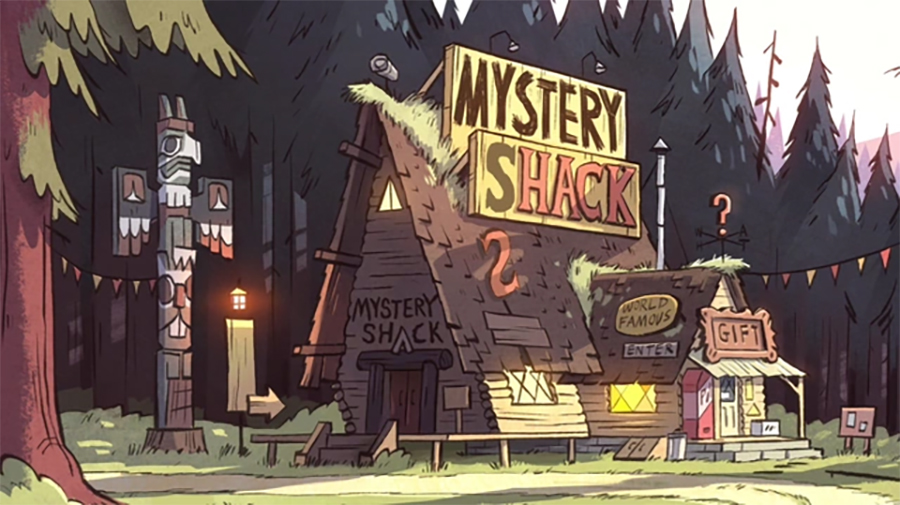
Gravity Falls is the adventures and misadventures of a pair of 12-year-old fraternal twins who are sent off to spend the summer with their great-uncle Stan, who has converted his backwoods cabin into a tourist trap that he calls “The Mystery Shack.”
The inspiration for the show, Hirch told reporters, was the “mystery” type roadside attractions that he used to visit with his family when he and his twin sister were young. Places like “The Mystery Spot,” a short distance from his home in the San Francisco Bay area — and the attraction that inspired The Mystery Spot: The Oregon Vortex and House of Mystery, near the town of Gold Hill.
THE OREGON VORTEX is a prime contender for Oregon’s most successful roadside attraction, with the exception of the Sea Lion Caves. Not too many years ago, there were a lot of these around — especially on tourism-heavy routes like Highway 101 on the coast. They sported names like “Prehistoric Gardens,” “The Sea Gulch,” and “Trees of Mystery”; vacationing families would stop and visit them on their way through.
The golden age of roadside attractions is mostly a kitschy memory today, as the style of vacationing families has changed over the years. Some of them closed down quietly — like Sea Gulch, in Seal Rock, which now houses a woodcarving outlet. At least one went down in infamy — West Coast Game Park Safari in Bandon was shut down earlier this year after its owner apparently watched The Tiger King on Netflix and mused, “I can top that! I just need more illegal drugs and firearms and suspicious stacks of cash, and less feeding the animals.”
Others are still going strong, including Prehistoric Gardens — and, of course, The Oregon Vortex and House of Mystery.
THE OREGON VORTEX is something of an outlier. It’s not really on the way to anywhere, although it’s only about five miles off Interstate 5; it’s not hard to reach, but drive-by-drop-in traffic — a major part of other roadside attractions’ business — is nonexistent.
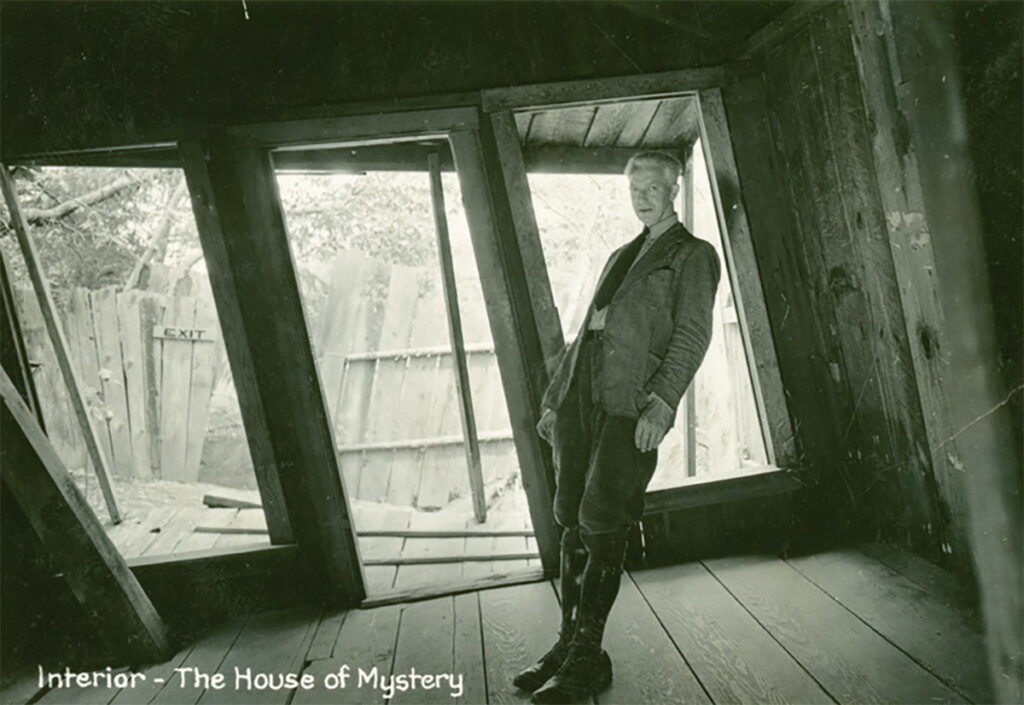
But, there’s something kind of special about the Vortex. Water appears to run uphill there. People’s height changes from one side of a plank to another.
Among the skeptical, the general consensus is that it creates those outcomes through skillful framing and optical illusions, and that there is nothing supernatural or mysterious about it.
But if you ask them, the operators will tell you it’s because of a confluence of magnetic influences that actually warp the fabric of space — causing massive old-growth fir trees to grow at a slant, and objects to appear bigger or smaller depending on where they are relative to that force field.
And plenty of visitors come away convinced that they are right.
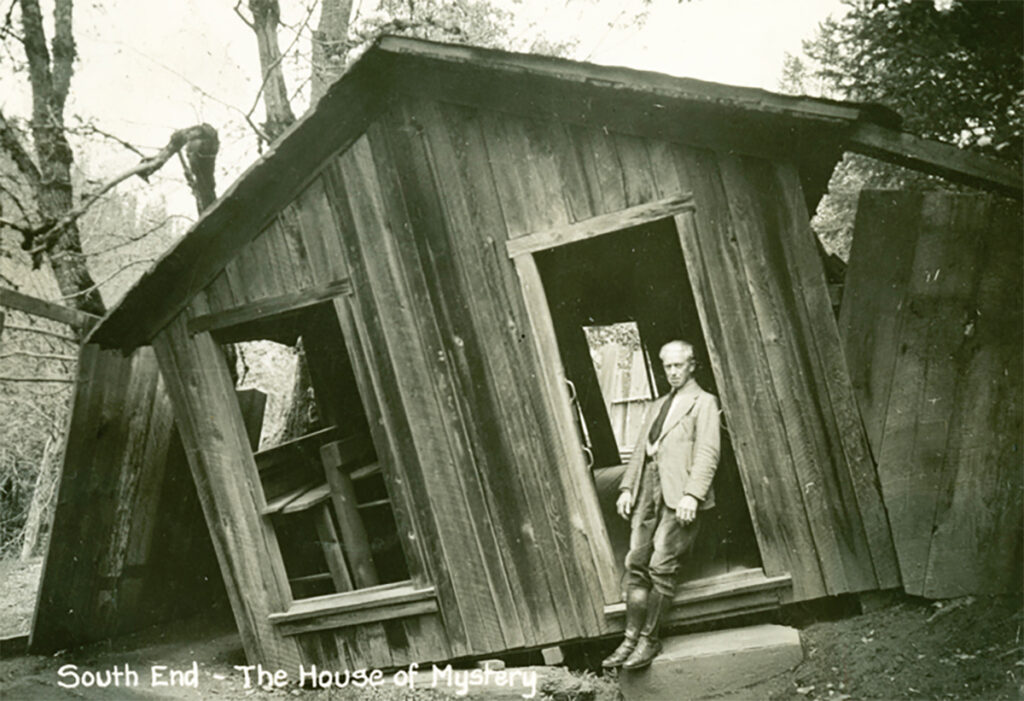
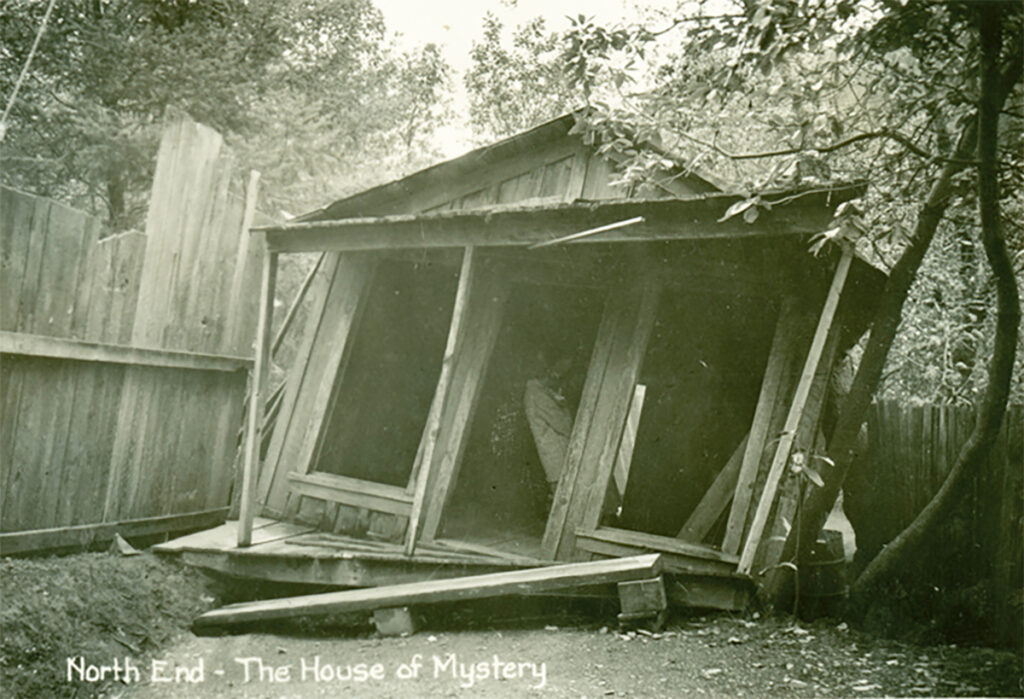
THE VORTEX DATES back to 1914, when a prospector named William McCollugh stumbled across the assaying shack for the Old Grey Eagle Mine. The shack had been knocked off its foundation by some sort of geographical disruption — maybe a flood — and found its way to the current spot, half collapsed sideways by its ordeal. Exploring inside, McCollugh noticed the strange way that gravity seemed to misbehave, and noted the trees growing at a strange uniform angle out of the hillside — and wondered what could be the cause.
Luckily, he had a friend who could, he thought, tell him. So he wrote to his friend John Litster, a Scottish geologist and mining engineer.
Litster was intrigued enough to board an ocean liner and come see for himself. What he found left him very excited. Convinced he was looking at the effect of some strange unseen magnetic force, a “vortex of magnetism” in the Earth’s crust, he shored up the shack so that it was no longer unsafe for occupancy and then, in 1930, he opened The Oregon Vortex and House of Mystery as a tourist attraction.
For decades, skeptics have scoffed. The effect of people’s heights changing has been ascribed to something called a “Ponzo illusion,” in which heavy chevron-shaped lines bracketing two identical figures cause the eye to perceive height differences in them. Also, without any horizon line or point of reference, it’s hard to really know for sure if that water really is flowing uphill in the House of Mystery.
So, is the Oregon Vortex simply a monument to 80 years of psychological suggestion and expert illusioneering? Or is there really something unusual about the place? Could there be a real scientific basis for this pseudoscientific-sounding “force field” theory?
Maybe the most compelling evidence that it’s not real, that it’s all an illusion, and that there is no “force field,” is the success of copycat attractions that have sprung up in places closer to tourist routes in the years since. These places replicate the general form of the House of Mystery, and the same effects happen there — which suggests that it’s the shape of the shack that stars in the show, not its location relative to a magnetic force field.
The first one of these copycats to be built was The Mystery Spot, down in Santa Cruz, in 1939 — at least, it was the first one to come to Lister’s attention. Litster sued its operator for copying his setup, but withdrew the suit when someone pointed out that one could not copyright natural phenomena.
Over the subsequent 20 years, the landscape of North America became peppered with Gravity Hills, Magnetic Hills, Mystery Spots, (State Name) Vortexes, and similar tourist traps.
But there really is something special about the Oregon Vortex.
“Tennis balls really do seem to roll uphill there,” writes RoadsideAmerica.com. “Brooms really do stand on end. After subjecting many spots to rigorous, very scientific tests, our Mystery Spot Test Kit indicates that the Oregon Vortex is the most disturbed.”
Also, the operators of the Vortex have pretty much always maintained an open-door policy to the skeptics. Photographs are encouraged; skeptical investigations meet with enthusiastic cooperation and even offers of free admission to the site while investigating. It’s difficult to imagine an elaborate con job surviving this kind of openness combined with the sort of scrutiny paranormal claims always inspire, for such a long period of time, even in a relatively remote corner of southern Oregon.
Or maybe that openness is just part of the show. Either way, the place is a wonderful piece of Oregon history, and well worth checking out.
IF ONLY THIS story could end here, with a little encouragement to check out this historic and fascinating place. Unfortunately, in March of this year, at the beginning of the tourist season, Sardine Creek rose above its banks high enough to send millions of gallons of fast-flowing water pouring above the floors in the gift shop.
Luckily, the water didn’t get high enough to duplicate whatever happened to the House of Mystery in 1914, but it made an enormous mess and inflicted thousands of dollars’ worth of damage on the historic building — and the property was not insured against flood damage. The operators tried to keep things going for the summer season, but in August they were forced to close it so that crews could work to save and repair the historic structures. But they were not able to get enough done by the end of the summer to allow them to re-open on their usual schedule, next March; and to preserve the salmon run in Sardine Creek (that would be the sardines, of course) they can’t run construction equipment again until June 2026.
Everyone is hoping they can get it reopened soon, and that they can financially keep it together in the meantime (roadside attractions are famous for being run on a shoestring, even historical and world-famous ones). For anyone who wants to help, they have set up a GoFundMe campaign, which can be found through their Facebook page.
(Sources: Facebook.com/oregonvortex; “Oregon Vortex (House of Mystery),” an article by Maureen Flanagan Battistella published June 1, 2022, on the Oregon Encyclopedia; www.oregonvortex.com; “Mystery Spots,” an article on RoadsideAmerica.com accessed Oct. 26, 2025; “Disney’s Gravity Falls …,” an article by Todd VanDerWerff published Aug. 1, 2014, on vox.com; “Creator Alex Hirsch talks Gravity Falls …,” an article by Christina Radish published July 6, 2012, in collider.com.)
Finn J.D. John teaches at Oregon State University and writes about odd tidbits of Oregon history. His most recent book, Bad Ideas and Horrible People of Old Oregon, published by Ouragan House last year. To contact him or suggest a topic: [email protected] or 541-357-2222.