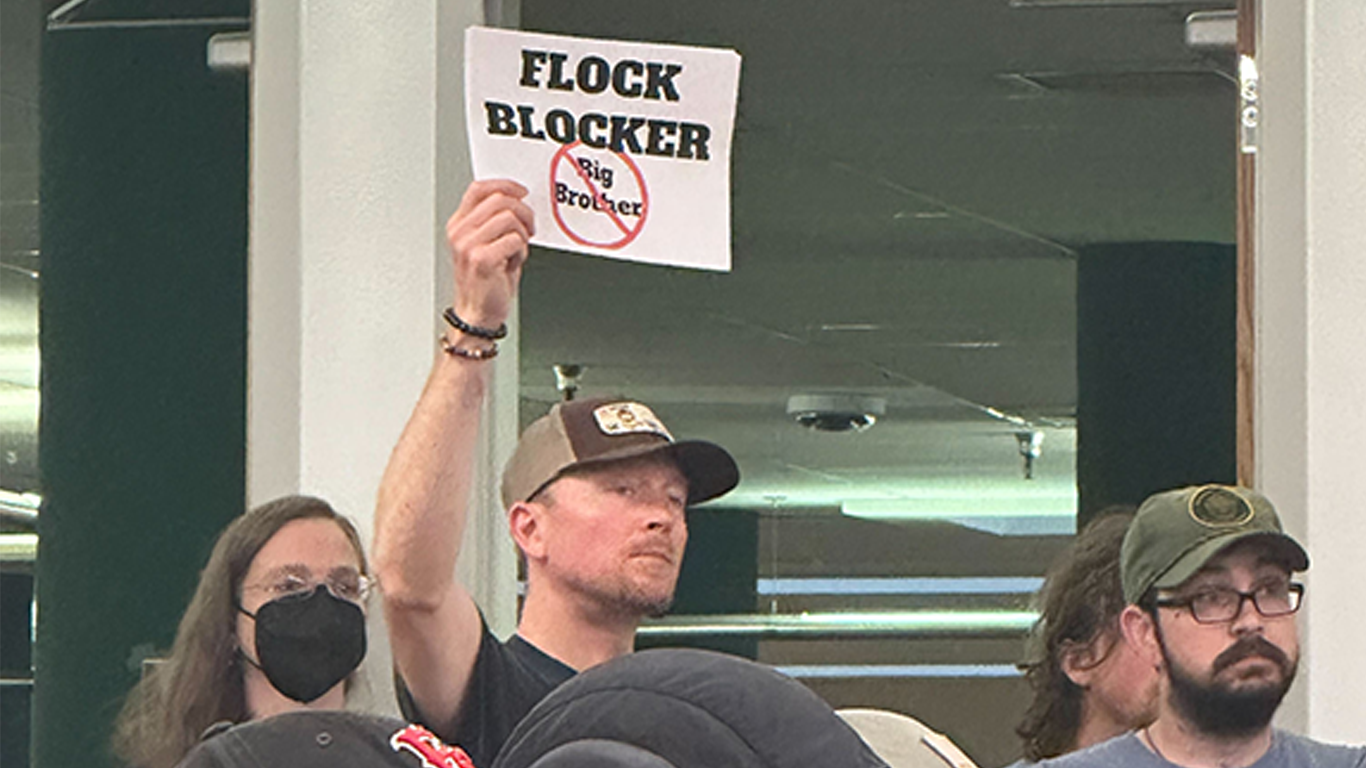
SPRINGFIELD – A wide dynamic range of public commenters addressed the Springfield City Council on Monday, with all eight speakers opposing the recent installation of Flock security cameras around town, emphasizing a tension between the desire for enhanced safety and the need to protect individual privacy and civil liberties.
A pattern is emerging, as at the Sept. 2 city council meeting, a dozen residents raised concerns about privacy invasion and data sharing related to the placement of cameras in residential areas versus retail spaces. Questions arose about the cameras’ effectiveness in deterring crime, along with concerns that mass surveillance would foster distrust in the community and impact residents’ behavior.
The installation of the cameras came as a surprise to citizens when police put up 25 Flock Safety license-plate recognition cameras on Sept. 26.
The Springfield Police Department released a statement explaining that the cameras are part of a grant-funded retail theft prevention initiative, installed to meet the funding deadline.
In the statement, SPD said the cameras have yet to be activated; however, during the installation process, they were all briefly turned on for calibration. Once each camera has been verified, it will be deactivated “until a broader community discussion takes place,” according to the release.
Community concerns
Ky Fireside was a familiar figure who had previously expressed her concerns about data security to the council. Fireside stated that Flock is an untrustworthy company, having been caught misleadingly claiming that they shared data with federal agencies without the knowledge of the departments that owned the data. Fireside referenced a recent incident in Evanston, Illinois, where the city installed cameras and later ordered their removal.
“Their contract was canceled because Flock allowed Border Patrol to access data in a sanctuary state. Flock broke the law,” Fireside said. “The devices were supposed to be deactivated. Flock continued collecting data against the city’s orders. … Evanston had to physically cover their Flock devices with black plastic hoods to prevent the continuation of data gathering because Flock ignored a cease and desist order,” Fireside said.
The City of Evanston confirmed the malpractice, and in an Aug. 26 statement, noted that, “Flock’s admission that it failed to establish distinct permissions and protocols to ensure local compliance while running a pilot program with federal users, is deeply troubling.”
The pilot program was run in collaboration with U.S. Customs and Border Protection, according to an NBC Chicago article published on Aug. 26.
She said similar issues are persistent with Springfield’s cameras.
“I have been archiving Springfield’s Flock transparency page regularly since July. It has consistently listed zero vehicles tracked, but it now lists 64,012 unique vehicles detected in the last 30 days,” Fireside said.
According to the SPD-issued news release, “As installation continues, vehicle counts on the Transparency Portal may temporarily increase due to these calibration periods.”
Ken Wallace, a resident of Eugene, was passionate about the safety of his autistic daughter. Wallace noted that Flock cameras come with gait tracking software to track a person’s walking style, which is used to detect public intoxication.
“There is a real and honest fear in the autism community in Eugene now that those of us with autistic children who have strange walks and gaits cannot go on walks now without being flagged by this system and the cops showing up and harassing us,” Wallace said.
He said his evening strolls with his family have turned worrisome, with the fear of being flagged just because of the way his daughter walks.
“It starts to affect how you live, it starts to affect your view of yourself. You begin to feel marginalized, you begin to feel targeted. You also begin to feel unvalued. It can feel like a data point,” he said.
Dale Tronrud, another Springfield resident, brought up a point about the cameras on Franklin Blvd. having access to view the Planned Parenthood clinic.

“By placing cameras on both sides of the clinic, they can determine how long each car spends on the Boulevard near the clinic,” Tronrud said. “Those cars that spend more than a couple of minutes will stand out like a sore thumb and be easily identified and targeted.”
Tronrud said that although Flock Safety gave its word to Sen. Ron Wyden that data from Oregon would not be released to others, Tronrud is concerned that once the data is in a database where tens of thousands of people are granted access, it imposes little control.
“Besides, a policy that can be created in an afternoon can just as easily be created or be changed later with no notice given. They are under no legal obligation to hold to their word,” Tronrud said.
Other speakers noted a lack of trust in the city for installing the cameras before considering community input.
Jeff Solana noted that Flock’s valuation is around $8 billion, primarily driven by venture capital funding. He said that Allied Security, the company with the little blue octagonal signs, which has been around for decades, only has a valuation of $3-4 billion.
Flock’s website notes a recent $275 million grant, bringing their valuation to $7.5 billion.
“There is a certain interest and motivation behind the spread of Flock that is not purely for security. This is a money-making operation controlled by a private entity that seeks only data about all of us,” Solana said.
Jason Prophet, a Springfield resident, spoke on what he feels is “an invasion of privacy” and “a waste of money.”
“I don’t know why we’re an experiment for these Flock cameras. I think they ought to be taken down. There’s $50,000 worth of cameras hanging in the city. That’s too much,” he said.
Prophet mentioned how the money should be used for other priorities, since the city has a fire levy up for a vote.
“Now there’s a fire levy you’re asking for. Not until the city starts getting rid of some assets like the bank building, the grader, the brush cutter never gets used. I tell everybody to vote no on that levy,” Prophet said.
Continuing the conversation
The Springfield City Council is considering potential solutions to address community concerns regarding the installation of Flock surveillance systems. Key proposals include enhancing community engagement through public forums, implementing transparency measures about data usage, and revising camera locations based on public feedback.
Additionally, the council noted at its September meeting that it may explore stricter data privacy safeguards to prevent the misuse of shared information, investigate alternative safety strategies that do not involve surveillance, and consider pilot programs to assess public reception. Regular reviews and audits of the system’s compliance with privacy regulations are also being discussed to ensure a balance between public safety and residents’ privacy rights.
According to an Oct. 8 article by The Daily Emerald, “The Eugene City Council voted 8-0 to pass a motion recommending the City Manager Sarah Medary to pause all Flock Safety camera activity at a council meeting on Wednesday.”
“A lot of us in this room are feeling very uncomfortable and unsure about what is happening,” Councilor Kori Rodley said, noting the council’s plans to “dig into this in a work session where we can really understand it and figure out the best path forward.”
A work session is scheduled for 6 p.m. on Monday, Oct. 20, to facilitate further discussion among the council before convening into a regular meeting at 7 p.m., where public comments will be heard. The council does not accept public comment at work session meetings.
If you would like to submit written public comment during the Business from the Audience or a Public Hearing listed on the agenda in advance, email [email protected] no later than 3 p.m. the day of the meeting.